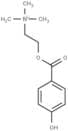
CAS 5094-31-5
:p-Hydroxybenzoylcholine
Description:
p-Hydroxybenzoylcholine, with the CAS number 5094-31-5, is a chemical compound that belongs to the class of quaternary ammonium compounds. It is characterized by the presence of a hydroxy group and a benzoyl moiety attached to a choline structure, which contributes to its biological activity. This compound is typically soluble in water due to the presence of the quaternary ammonium group, which enhances its ionic character. p-Hydroxybenzoylcholine is known for its potential applications in pharmacology, particularly in the study of neurotransmission and as a potential therapeutic agent. Its structure allows it to interact with various biological receptors, making it of interest in medicinal chemistry. Additionally, it may exhibit antioxidant properties due to the hydroxy group, which can scavenge free radicals. Overall, p-Hydroxybenzoylcholine is a compound of interest in both chemical and biological research, with implications for understanding its role in physiological processes and potential therapeutic uses.
Formula:C12H18NO3
InChI:InChI=1S/C12H17NO3/c1-13(2,3)8-9-16-12(15)10-4-6-11(14)7-5-10/h4-7H,8-9H2,1-3H3/p+1
InChI key:InChIKey=BAPAICNRGIBFJT-UHFFFAOYSA-O
SMILES:C(OCC[N+](C)(C)C)(=O)C1=CC=C(O)C=C1
Synonyms:- 2-[(4-Hydroxybenzoyl)oxy]-N,N,N-trimethylethanaminium
- 4-Hydroxybenzoylcholine
- Choline, p-hydroxybenzoate (ester)
- p-Hydroxybenzoylcholine
- Ethanaminium, 2-[(4-hydroxybenzoyl)oxy]-N,N,N-trimethyl-
Sort by
Purity (%)
0
100
|
0
|
50
|
90
|
95
|
100
Found 2 products.
4-Hydroxybenzoyl choline
CAS:4-Hydroxybenzoyl choline is a natural product for research related to life sciences. The catalog number is TN6602 and the CAS number is 5094-31-5.Formula:C12H18NO3Purity:98%Color and Shape:SolidMolecular weight:224.284-Hydroxybenzoyl choline
CAS:4-Hydroxybenzoyl choline is a synthetic choline ester derived from a specific modification of choline, which is commonly sourced from natural compounds. This product exhibits a biochemical mode of action, potentially interacting with cholinergic receptors, similar to other choline-based entities. Its ability to mimic or interfere with acetylcholine signaling pathways makes it a subject of interest in neuropharmacological research.Formula:C12H18NO3Purity:Min. 95%Molecular weight:224.28 g/mol