CAS 51050-59-0
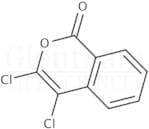
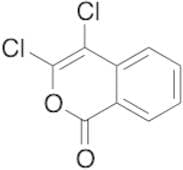
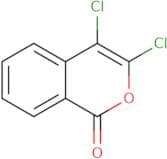
:3,4-dichloroisocoumarin
Description:
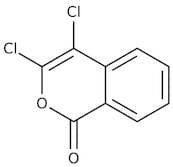
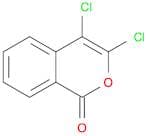
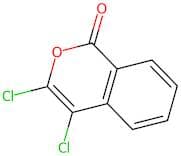
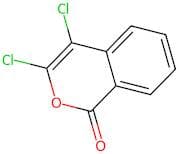
3,4-Dichloroisocoumarin is a synthetic organic compound characterized by its isocoumarin structure, which features a fused benzene and lactone ring. It is a derivative of isocoumarin, with two chlorine atoms substituted at the 3 and 4 positions of the aromatic ring, contributing to its unique chemical properties. This compound is typically a solid at room temperature and is known for its potential applications in various fields, including medicinal chemistry and as a reagent in organic synthesis. 3,4-Dichloroisocoumarin exhibits moderate solubility in organic solvents, while its solubility in water is limited. The presence of chlorine atoms enhances its reactivity, making it useful in the synthesis of other chemical compounds. Additionally, it may exhibit biological activity, which has been explored in research contexts. As with many chlorinated compounds, safety precautions should be taken when handling 3,4-dichloroisocoumarin due to potential toxicity and environmental concerns.
Formula:C9H4Cl2O2
InChI:InChI=1/C9H4Cl2O2/c10-7-5-3-1-2-4-6(5)9(12)13-8(7)11/h1-4H
SMILES:c1ccc2c(c1)c(c(Cl)oc2=O)Cl
Synonyms:- 3,4-Dichloro-isocoumarin
- 3,4-dichloro-1H-isochromen-1-one
Sort by
Purity (%)
0
100
|
0
|
50
|
90
|
95
|
100
Found 9 products.
3,4-Dichloroisocoumarin, 98%
CAS:Reversible inhibitor of serine proteasesFormula:C9H4Cl2O2Purity:98%Molecular weight:215.033,4 Dichloroisocoumarin
CAS:3,4 Dichloroisocoumarin is a granzyme, cathepsin G, and neutrolphil elastase inhibitor
Formula:C9H4Cl2O2Purity:97.94%Color and Shape:SolidMolecular weight:215.033,4 Dichloroisocoumarin
CAS:Controlled ProductApplications 3,4 Dichloroisocoumarin is a granzyme, cathepsin G, and neutrolphil elastase inhibitor.
Formula:C9H4Cl2O2Color and Shape:NeatMolecular weight:215.0333,4-Dichloroisocoumarin
CAS:3,4-Dichloroisocoumarin is an organic compound that has been shown to be a potent inhibitor of nuclear DNA polymerase. It has been shown to be a potential drug target for cancer treatment due to its ability to inhibit the polymerase chain reaction (PCR) and interfere with DNA replication. 3,4-Dichloroisocoumarin has also been shown to have reactive properties, which may lead to cell death by damaging cellular components such as proteins and lipids. The enzyme activity of 3,4-Dichloroisocoumarin is unknown. However, it is thought that the inhibition of DNA synthesis by this compound may be due to its ability to bind DNA in a manner that prevents transcription or replication.Formula:C9H4Cl2O2Purity:Min. 95%Color and Shape:PowderMolecular weight:215.03 g/mol