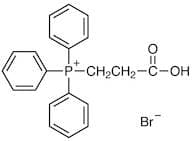
CAS 51114-94-4
:Phosphonium, (2-carboxyethyl)triphenyl-, bromide (1:1)
- (2-Carboxyethyl)(triphenyl)phosphonium bromide
- (β-Carboxyethyl)triphenylphosphonium bromide
- 3-(Triphenylphosphonium)propionic acid bromide
- NSC 84145
- Phosphonium, (2-Carboxyethyl)Triphenyl-, Bromide (1:1)
- Phosphonium, (2-carboxyethyl)triphenyl-, bromide
- (2-Carboxyethyl)triphenylphosphonium bromide
(2-Carboxyethyl)triphenylphosphonium Bromide
CAS:Formula:C21H20BrO2PPurity:>96.0%(T)(HPLC)Color and Shape:White to Light yellow powder to crystalMolecular weight:415.27(2-CARBOXYETHYL)TRIPHENYLPHOSPHONIUM BROMIDE
CAS:Formula:C21H20BrO2PPurity:97%Color and Shape:SolidMolecular weight:415.2601(2-Carboxyethyl)(triphenyl)phosphonium bromide
CAS:(2-Carboxyethyl)(triphenyl)phosphonium bromideFormula:C21H20O2P·BrPurity:97%Color and Shape: white solidMolecular weight:415.26g/mol(2-Carboxyethyl)triphenylphosphonium bromide
CAS:Purity:98%Color and Shape:SolidMolecular weight:415.272-Carboxyethyl(triphenyl)phosphonium bromide
CAS:2-Carboxyethyl(triphenyl)phosphonium bromide is a phosphonium salt that inhibits the adenosine receptors. It is also shown to have anti-cancer effects on cells. 2-Carboxyethyl(triphenyl)phosphonium bromide has been shown to inhibit the growth of cancer cells in cell culture and in animal models. It has been proposed as a potential therapeutic agent for neurodegenerative diseases, such as Parkinson's disease and Huntington's disease, due to its ability to inhibit the activity of the enzyme formylation. The drug binds to nucleophilic sites on proteins, which may be due to its structure activity relationship with adenosine receptors. The synthesis of this drug involves ethyl formate as a starting material, which undergoes an amination reaction with diisobutylaluminium followed by formylation with dibromomethane in acid catalyst conditions.
Formula:C21H20O2PBrPurity:Min. 95%Molecular weight:415.26 g/mol