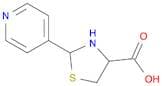
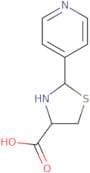
CAS 51226-84-7
:2-(pyridin-4-yl)-1,3-thiazolidine-4-carboxylic acid
Description:
2-(Pyridin-4-yl)-1,3-thiazolidine-4-carboxylic acid, with the CAS number 51226-84-7, is a heterocyclic compound featuring a thiazolidine ring substituted with a pyridine moiety. This compound typically exhibits characteristics common to thiazolidines, such as the presence of a five-membered ring containing both sulfur and nitrogen atoms. The carboxylic acid functional group contributes to its acidity and potential reactivity, making it useful in various chemical reactions and applications. The pyridine ring enhances its biological activity and solubility in polar solvents. This compound may exhibit properties such as antimicrobial, anti-inflammatory, or other pharmacological activities, which are often explored in medicinal chemistry. Its structural features allow for potential interactions with biological targets, making it a candidate for drug development. Overall, 2-(pyridin-4-yl)-1,3-thiazolidine-4-carboxylic acid is of interest in both synthetic and medicinal chemistry due to its unique structure and potential applications.
Formula:C9H10N2O2S
InChI:InChI=1/C9H10N2O2S/c12-9(13)7-5-14-8(11-7)6-1-3-10-4-2-6/h1-4,7-8,11H,5H2,(H,12,13)
SMILES:c1cnccc1C1NC(CS1)C(=O)O
Synonyms:- 2-(4-Pyridyl)-1,3-Thiazolane-4-Carboxylic Acid
- 4-Thiazolidinecarboxylic acid, 2-(4-pyridinyl)-
- 2-(Pyridin-4-yl)-1,3-thiazolidine-4-carboxylic acid
Sort by
Purity (%)
0
100
|
0
|
50
|
90
|
95
|
100
Found 2 products.
2-(Pyridin-4-yl)-1,3-thiazolidine-4-carboxylic acid
CAS:2-(Pyridin-4-yl)-1,3-thiazolidine-4-carboxylic acid is a glycol ether with a hydrocarbon group. It is used as an ethoxylate in the production of surfactants and cationic surfactants. This chemical has been shown to inhibit the growth of microorganisms such as fungi and bacteria. 2-(Pyridin-4-yl)-1,3-thiazolidine-4-carboxylic acid can be used as an emulsifier to make lemongrass oil more soluble in water. It also has antifungal properties, which may be due to its ability to inhibit fatty acid synthesis by inhibiting the enzyme acetyl coenzyme A carboxylase (ACCase).
Formula:C9H10N2O2SPurity:Min. 95%Molecular weight:210.26 g/mol