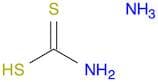
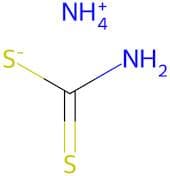
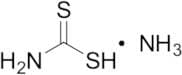
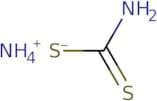
CAS 513-74-6
:Ammonium dithiocarbamate
Description:
Ammonium dithiocarbamate, with the CAS number 513-74-6, is an inorganic compound characterized by its dithiocarbamate functional group. It typically appears as a white to light yellow crystalline solid and is soluble in water, which makes it useful in various applications. This compound is known for its role as a reagent in organic synthesis and as a precursor in the production of other dithiocarbamate derivatives. It exhibits properties such as being a chelating agent, which allows it to form complexes with metal ions, enhancing its utility in agriculture as a fungicide and pesticide. Additionally, ammonium dithiocarbamate can be used in the mining industry for the flotation of minerals. Its chemical stability is moderate, and it should be handled with care due to potential toxicity and environmental concerns. Overall, ammonium dithiocarbamate is a versatile compound with significant applications in both industrial and agricultural sectors.
Formula:CH6N2S2
InChI:InChI=1/CH3NS2.H3N/c2-1(3)4;/h(H3,2,3,4);1H3
InChI key:InChIKey=DCYNAHFAQKMWDW-UHFFFAOYSA-N
SMILES:C(N)(=S)S.N
Synonyms:- Ammonium sulfocarbamate
- Carbamic acid, dithio-, monoammonium salt
- Carbamic acid, dithio-, monoammonium salt (8CI)
- Carbamodithioic Acid
- Carbamodithioic Acid Ammoniate
- Carbamodithioic acid, ammonium salt (1:1)
- Carbamodithioic acid, monoammonium salt
- Dithiocarbamic acid monoammonium salt
- Hsdb 5675
- Hydrazinecarbodithioic Acid
- Nsc 202959
- Ammonium dithiocarbamate
- Dithiocarbamic acid ammonium
- Nsc202959
- Carbamodithioic acid,ammonium salt
- ammonium dithiocarbamate NH4.CH2NS2
- Ammonium dithiocarbamate ISO 9001:2015 REACH
- AMMoniuM carbaModithioate
- Arotinolol impurity 3
- Dithiocarbamic acid ammonium salt
- See more synonyms
Sort by
Purity (%)
0
100
|
0
|
50
|
90
|
95
|
100
Found 4 products.
Ammoniumdithiocarbamate
CAS:Ammoniumdithiocarbamate is a group p2 compound that reacts with hydrochloric acid to form a dithiocarbamic acid. This reaction is reversible and an equilibrium between the two compounds exists. Ammoniumdithiocarbamate can be used to synthesize nucleophilic substitutions, which are used in many industrial applications. The reactivity of ammoniumdithiocarbamate is increased by the presence of amp-activated protein, which increases hydrogen bonding interactions with the dithiocarbamic acid. Ammoniumdithiocarbamate has been shown in animal studies to inhibit inflammatory diseases and lung damage caused by carbon disulphide.Formula:CH6N2S2Purity:Min. 95%Color and Shape:PowderMolecular weight:110.2 g/mol