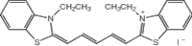
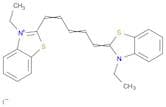
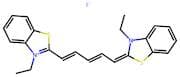
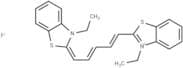
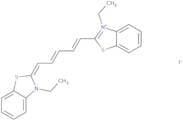
CAS 514-73-8
:Dithiazine
Description:
Dithiazine, with the CAS number 514-73-8, is a heterocyclic compound characterized by a six-membered ring containing two nitrogen atoms and four sulfur atoms. This compound is part of the larger class of thiazines, which are known for their unique structural properties and reactivity. Dithiazine typically exhibits a yellow to brown coloration and is soluble in various organic solvents. Its molecular structure contributes to its potential applications in organic synthesis and as a building block for more complex molecules. The presence of both nitrogen and sulfur in its structure allows for interesting chemical behavior, including the ability to participate in various reactions such as nucleophilic substitutions and coordination with metal ions. Dithiazine's properties make it of interest in fields such as medicinal chemistry and materials science, although its practical applications may be limited due to stability concerns and the need for further research into its biological activity and safety profile.
Formula:C23H23N2S2·I
InChI:InChI=1S/C23H23N2S2.HI/c1-3-24-18-12-8-10-14-20(18)26-22(24)16-6-5-7-17-23-25(4-2)19-13-9-11-15-21(19)27-23;/h5-17H,3-4H2,1-2H3;1H/q+1;/p-1
InChI key:InChIKey=MNQDKWZEUULFPX-UHFFFAOYSA-M
SMILES:C(C)N1C=2C(SC1=CC=CC=CC3=[N+](CC)C=4C(S3)=CC=CC4)=CC=CC2.[I-]
Synonyms:- (4S)-1-Methyl-4-(1-methylethenyl)-7-oxabicyclo[4.1.0]heptane
- (4S)-1-Methyl-4-(1-methylvinyl)-7-oxabicyclo[4.1.0]heptane
- (4S)-1-Methyl-4-(prop-1-en-2-yl)-7-oxabicyclo[4.1.0]heptane
- (4S)-4-Isopropenyl-1-methyl-7-oxabicyclo[4.1.0]heptane
- 3,3′-Diethyl-2,2′-thiadicarbocyanine iodide
- 3,3′-Diethyldithiacarbodicyanine iodide
- 3,3′-Diethylthiadicarbocyanine iodide
- 3,3′-Diethylthiadicarbocyanine iodine
- 3-Ethyl-2-[5-(3-ethyl-2-benzothiazolinylidene)-1,3-pentadienyl]benzothiazolium iodide
- 3-Ethyl-2-[5-[3-ethyl-2(3H)-benzothiazolylidene]-1,3-pentadienyl]benzothiazolium iodide
- 7-oxabicyclo[4.1.0]heptane, 1-methyl-4-(1-methylethenyl)-, (4S)-
- Abminthic
- Anelmid
- Anguifugan
- Benzothiazolium, 3-ethyl-2-[5-(3-ethyl-2(3H)-benzothiazolylidene)-1,3-pentadien-1-yl]-, iodide (1:1)
- Benzothiazolium, 3-ethyl-2-[5-(3-ethyl-2(3H)-benzothiazolylidene)-1,3-pentadienyl]-, iodide
- Benzothiazolium, 3-ethyl-2-[5-(3-ethyl-2-benzothiazolinylidene)-1,3-pentadienyl]-, iodide
- Compound 01748
- Delvex
- Di-S-C<sub>2</sub>(5)
- Diethylthiadicarbocyanine iodide
- Dilombrin
- Dilombrine
- Dithiazanin iodide
- Dithiazine
- Dithiazine (dye)
- Dtdci
- Eastman 7663
- Netocyd
- Nk 136
- Omni-Passin
- Partel
- Si 1964
- T36 BOTJ A1 EY1& U1 & & (4S)- isomer
- Telmicid
- Telmid
- Telmide
- See more synonyms
Sort by
Purity (%)
0
100
|
0
|
50
|
90
|
95
|
100
Found 5 products.
3,3'-Diethylthiadicarbocyanine iodide
CAS:As a solvent soluble laser dyeFormula:C23H23IN2S2Purity:99%Color and Shape:Green, powder`Molecular weight:518.483,3'-Diethylthiadicarbocyanine iodide
CAS:Formula:C23H23IN2S2Purity:98%Color and Shape:SolidMolecular weight:518.4766Dithiazanine iodide
CAS:Dithiazanine iodide (Netocyd) is a benzothiazole.
Formula:C23H23IN2S2Purity:99.24% - 99.89%Color and Shape:SolidMolecular weight:518.483,3'-Diethylthiadicarbocyanine iodide
CAS:3,3'-Diethylthiadicarbocyanine iodide (DTTC) is a drug that is used to treat parasitic infections. It is an anthelmintic drug and has been shown to be effective in treating Trichuris trichiura, the most common worm infection of humans. DTTC inhibits the growth of parasites by binding to their cell membranes and inhibiting protein synthesis. This irreversible inhibition prevents the parasite from synthesizing proteins essential for life processes such as metabolism, reproduction, and movement. DTTC has been shown to be effective in experimental infection models with anthelmintic efficacy against Trichuris trichiura, Ascaris lumbricoides, Capillaria philippinensis, and Taenia taeniaeformis. There are no known side effects of this drug on human hosts when administered at therapeutic doses.Formula:C23H23N2S2•IPurity:Min. 95%Color and Shape:PowderMolecular weight:518.48 g/mol