CAS 5153-63-9
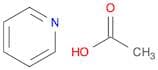
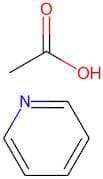
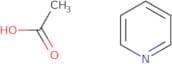
:Pyridinium acetate
Description:
Pyridinium acetate is an organic compound that consists of a pyridinium cation and an acetate anion. It is typically encountered as a white crystalline solid that is soluble in water and polar organic solvents. The compound is characterized by its hygroscopic nature, meaning it can absorb moisture from the air. Pyridinium acetate is often used in various applications, including as a buffer in biochemical and analytical chemistry due to its ability to maintain pH stability. It can also serve as a reagent in organic synthesis and as a source of pyridine derivatives. The presence of the pyridinium ion contributes to its basicity, while the acetate ion provides acidic properties, allowing for interesting interactions in solution. Additionally, pyridinium acetate can exhibit antimicrobial properties, making it of interest in pharmaceutical and agricultural applications. Safety data indicates that it should be handled with care, as with many chemical substances, to avoid potential irritation or adverse reactions.
Formula:C7H9NO2
InChI:InChI=1/C5H5N.C2H4O2/c1-2-4-6-5-3-1;1-2(3)4/h1-5H;1H3,(H,3,4)
InChI key:InChIKey=GAPYKZAARZMMGP-UHFFFAOYSA-N
SMILES:C=1C=CN=CC1.C(C)(O)=O
Synonyms:- Acetic acid pyridinyl salt
- Acetic acid, compd. with pyridine (1:1)
- Pyridinal acetate
- Pyridine Acetate (1:1)
- Pyridine, acetate
- Pyridinium acetate
- pyridin-1-ium:acetate
Sort by
Purity (%)
0
100
|
0
|
50
|
90
|
95
|
100
Found 3 products.
Pyridinium acetate
CAS:Controlled Product<p>Pyridinium acetate is a chemical compound with the molecular formula of C6H5N3O2. It is a white solid with a melting point of 61 °C. This compound belongs to the class of organic compounds called heterocycles, which contain atoms other than carbon in their ring structures. Pyridinium acetate has been shown to have an inhibitory effect on collagen synthesis and can be used for the treatment of high blood pressure. The synthesis of pyridinium acetate is done by a synthetase enzyme that requires ATP, citric acid, and sodium citrate as substrates. This pathway creates pyridinium acetate from two molecules of aspartic acid and one molecule of acetic acid. The final product contains a carbonyl group, which gives it its acidic properties. Pyridinium acetate also has an acidic pH optimum at 3-4 and is resistant to mutants such as E. coli K-12 that</p>Formula:C5H5N·C2H4O2Purity:Min. 95%Color and Shape:PowderMolecular weight:139.15 g/mol