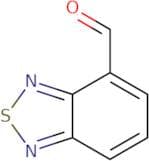
CAS 5170-68-3
:2,1,3-benzothiadiazole-4-carbaldehyde
Description:
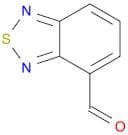
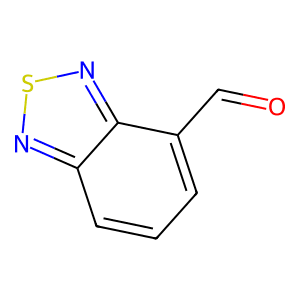
2,1,3-Benzothiadiazole-4-carbaldehyde, with the CAS number 5170-68-3, is an organic compound characterized by its unique bicyclic structure that incorporates both a benzothiadiazole moiety and an aldehyde functional group. This compound typically appears as a solid or crystalline substance and is known for its potential applications in organic electronics, particularly in the development of organic semiconductors and fluorescent materials. The presence of the thiadiazole ring contributes to its electronic properties, making it a candidate for use in various optoelectronic devices. Additionally, the aldehyde group can participate in further chemical reactions, allowing for the synthesis of derivatives that may enhance its functionality. The compound is generally stable under standard conditions but may undergo reactions typical of aldehydes, such as oxidation or condensation. Its solubility can vary depending on the solvent, and it is important to handle it with care due to potential reactivity. Overall, 2,1,3-benzothiadiazole-4-carbaldehyde is a significant compound in the field of materials science and organic chemistry.
Formula:C7H4N2OS
InChI:InChI=1/C7H4N2OS/c10-4-5-2-1-3-6-7(5)9-11-8-6/h1-4H
SMILES:c1cc(C=O)c2c(c1)nsn2
Sort by
Purity (%)
0
100
|
0
|
50
|
90
|
95
|
100
Found 4 products.
2,1,3-Benzothiadiazole-4-carbaldehyde
CAS:Formula:C7H4N2OSPurity:98%Color and Shape:SolidMolecular weight:164.18452,1,3-Benzothiadiazole-4-carboxaldehyde
CAS:2,1,3-Benzothiadiazole-4-carboxaldehydeFormula:C7H4N2OSPurity:96%Color and Shape: orange crystalline solidMolecular weight:164.18g/mol2,1,3-Benzothiadiazole-4-carboxaldehyde
CAS:2,1,3-Benzothiadiazole-4-carboxaldehyde is a phosphodiesterase inhibitor that has been shown to have inotropic effects. It is also a heterocyclic compound and an organic alkali. 2,1,3-Benzothiadiazole-4-carboxaldehyde inhibits the enzymatic activity of phosphodiesterases by binding to the active site of the enzyme and preventing the hydrolysis of phosphodiesters. This inhibition leads to an increase in intracellular cAMP levels which can cause an increase in cardiac contractility and vasodilation. In addition, 2,1,3-benzothiadiazole-4-carboxaldehyde binds to benzoxadiazole and benzothiadiazole receptors which may lead to biological responses such as bronchoconstriction or vasodilation.Formula:C7H4N2OSPurity:Min. 95%Molecular weight:164.18 g/mol


![Benzo[c][1,2,5]thiadiazole-4-carbaldehyde](/_next/image/?url=https%3A%2Fstatic.cymitquimica.com%2Fproducts%2F10%2Fthumb%2FF237508.jpg&w=3840&q=75)