CAS 51751-34-9
:4-Hydroxy-2-oxo-2H-chromene-3-carbaldehyde
Description:
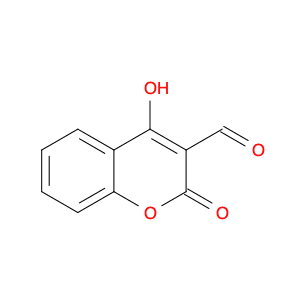
4-Hydroxy-2-oxo-2H-chromene-3-carbaldehyde, also known as coumarin-3-carbaldehyde, is a chemical compound characterized by its chromene structure, which features a benzopyran ring system. This compound contains a hydroxyl group (-OH) and an aldehyde group (-CHO), contributing to its reactivity and potential applications in organic synthesis. It typically appears as a pale yellow to light brown solid or liquid, depending on its purity and form. The presence of the aldehyde group makes it susceptible to oxidation and condensation reactions, while the hydroxyl group can participate in hydrogen bonding, influencing its solubility and interaction with other molecules. This compound is of interest in various fields, including medicinal chemistry, due to its potential biological activities, such as anti-inflammatory and antioxidant properties. Additionally, it can serve as a building block in the synthesis of more complex organic compounds. Proper handling and storage are essential, as with many organic compounds, to ensure safety and stability.
Formula:C10H6O4
InChI:InChI=1/C10H6O4/c11-5-7-9(12)6-3-1-2-4-8(6)14-10(7)13/h1-5,12H
SMILES:c1ccc2c(c1)c(c(C=O)c(=O)o2)O
Synonyms:- 2H-1-benzopyran-3-carboxaldehyde, 4-hydroxy-2-oxo-
Sort by
Purity (%)
0
100
|
0
|
50
|
90
|
95
|
100
Found 3 products.
4-Hydroxy-2-oxo-2H-chromene-3-carbaldehyde
CAS:Formula:C10H6O4Purity:95%Color and Shape:SolidMolecular weight:190.15224-Hydroxy-3-formylcoumarin
CAS:4-Hydroxy-3-formylcoumarin is a coumarin derivative that has been shown to have antitumor activity in vivo against the L1210 murine leukemia. It has also been shown to be effective against the tetranuclear form of the cancer cells. 4-Hydroxy-3-formylcoumarin is also an important molecule for testing, as it is able to inhibit the growth of other types of tumor cells. This molecule has been found to be stable at neutral pH and in anhydrous sodium chloride solution. 4-Hydroxy-3-formylcoumarin can exist as two tautomeric forms: the erythro and threo isomers. The erythro form is more stable, with a higher activation energy than the threo form, which makes it more reactive for biological purposes.Formula:C10H6O4Purity:Min. 95%Color and Shape:PowderMolecular weight:190.15 g/mol