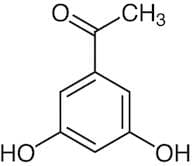
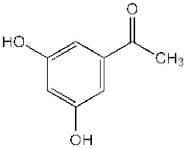
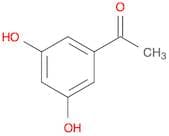
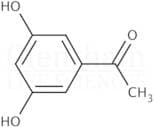
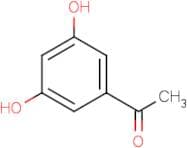
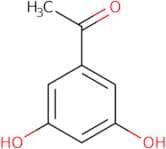
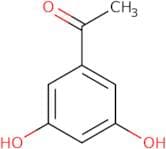
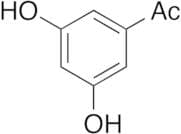
CAS 51863-60-6
:3,5-Dihydroxyacetophenone
Description:
3,5-Dihydroxyacetophenone, with the CAS number 51863-60-6, is an organic compound characterized by the presence of two hydroxyl (-OH) groups and an acetophenone moiety. It appears as a white to off-white crystalline solid and is soluble in organic solvents such as ethanol and acetone, but has limited solubility in water. The compound exhibits phenolic properties due to the hydroxyl groups, which can participate in hydrogen bonding and contribute to its reactivity. It is often used in organic synthesis and as an intermediate in the production of various chemical compounds. Additionally, 3,5-dihydroxyacetophenone may exhibit antioxidant properties and has potential applications in pharmaceuticals and materials science. Its melting point and boiling point can vary based on purity and environmental conditions, and it should be handled with care due to potential health hazards associated with phenolic compounds. Proper safety measures, including the use of personal protective equipment, are recommended when working with this substance.
Formula:C8H8O3
InChI:InChI=1S/C8H8O3/c1-5(9)6-2-7(10)4-8(11)3-6/h2-4,10-11H,1H3
InChI key:InChIKey=WQXWIKCZNIGMAP-UHFFFAOYSA-N
SMILES:C(C)(=O)C1=CC(O)=CC(O)=C1
Synonyms:- 1-(3,5-Dihydroxyphenyl)Ethanone
- 1-(3,5-Dihydroxyphenyl)ethan-1-one
- 3,5-Dihydroxyacetophenone
- 3′,5′-Dihydroxyphenyl methyl ketone
- 5-Acetylresorcinol
- Acetophenone, 3′,5′-dihydroxy-
- Ethanone, 1-(3,5-dihydroxyphenyl)-
Sort by
Purity (%)
0
100
|
0
|
50
|
90
|
95
|
100
Found 12 products.
3',5'-Dihydroxyacetophenone
CAS:Formula:C8H8O3Purity:>98.0%(GC)Color and Shape:Light yellow to Amber to Dark green powder to crystalMolecular weight:152.153',5'-Dihydroxyacetophenone, 96%
CAS:This Thermo Scientific Chemicals brand product was originally part of the Alfa Aesar product portfolio. Some documentation and label information may refer to the legacy brand. The original Alfa Aesar product / item code or SKU reference has not changed as a part of the brand transition to Thermo SciFormula:C8H8O3Purity:96%Color and Shape:Cream to pale brown, PowderMolecular weight:152.153',5'-Dihydroxyacetophenone
CAS:Formula:C8H8O3Purity:98%Color and Shape:SolidMolecular weight:152.14733,5-Dihydroxyacetophenone
CAS:3,5-Dihydroxyacetophenone is an endogenous metabolite widely used in biochemical experiments and drug synthesis research.Formula:C8H8O3Purity:99.47%Color and Shape:White To Off-White Crystalline PowderMolecular weight:152.153',5'-Dihydroxyacetophenone
CAS:3',5'-Dihydroxyacetophenone (3,5-DHAP) is a potent antioxidant that has been shown to inhibit the formation of reactive oxygen species. It is also an effective inhibitor of proteins with carbonyl groups such as pterostilbene, bambuterol and other drugs. 3,5-DHAP can be synthesized from carbohydrates by two routes, one of which involves a novel asymmetric synthesis. 3,5-DHAP has been used as a fluorescence probe for the detection of chloride ions in analytical methods.Formula:C8H8O3Purity:Min 98%Color and Shape:White PowderMolecular weight:152.15 g/mol3,5-Dihydroxyacetophenone
CAS:3,5-Dihydroxyacetophenone is a chemical intermediate that is used as a building block in organic synthesis. It can be used to synthesize other chemicals, such as pharmaceuticals, dyes, and perfumes. 3,5-Dihydroxyacetophenone is also an important reagent for the production of α-hydroxyketones. It can react with nucleophiles such as amines or alcohols to form esters or ethers. 3,5-Dihydroxyacetophenone is a versatile building block that can serve as a reaction component in various reactions. This compound is also used as a useful scaffold for the construction of complex molecules.Formula:C8H8O3Molecular weight:152.15 g/molRef: 3D-D-3420
-Unit-kgkgTo inquire1kgTo inquire5kgTo inquire250gTo inquire500gTo inquire2500gTo inquire3′,5′-Dihydroxyacetophenone
CAS:Formula:C8H8O3Purity:96%Color and Shape:SolidMolecular weight:152.1493',5'-Dihydroxyacetophenone
CAS:Controlled ProductApplications 3',5'-Dihydroxyacetophenone is a dihydroxy derivative of acetophenone. 3',5'-Dihydroxyacetophenone shows inhibitory activity towards plant germination and growth as well as some antitumor activity.
References Lohaus, E. et al.: Zeitsch. Naturforsch. C J. Biosci., 37C, 802 (1982); Nakamura, E.S. et al.: Cancer Lett., 177, 119 (2002);Formula:C8H8O3Color and Shape:NeatMolecular weight:152.15