CAS 5195-29-9
:4-Bromophenylglyoxal
Description:
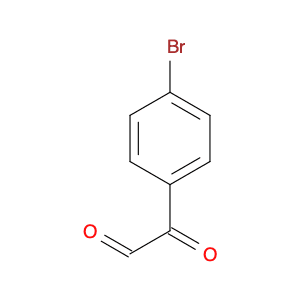
4-Bromophenylglyoxal is an organic compound characterized by its structure, which includes a bromine atom attached to a phenyl group and a glyoxal moiety. It typically appears as a yellow to brown solid and is known for its reactivity due to the presence of the aldehyde functional groups. This compound is often utilized in organic synthesis and can serve as an intermediate in the production of various pharmaceuticals and agrochemicals. Its reactivity allows it to participate in condensation reactions, making it valuable in the formation of more complex organic molecules. Additionally, 4-Bromophenylglyoxal may exhibit biological activity, which can be of interest in medicinal chemistry. Safety precautions should be taken when handling this compound, as it may pose health risks, including irritation to the skin and respiratory system. Proper storage conditions are also essential to maintain its stability and prevent degradation. Overall, 4-Bromophenylglyoxal is a versatile compound with significant applications in chemical research and development.
Formula:C8H5BrO2
InChI:InChI=1S/C8H5BrO2/c9-7-3-1-6(2-4-7)8(11)5-10/h1-5H
InChI key:InChIKey=LWOHGIMAROGMMF-UHFFFAOYSA-N
SMILES:C(C=O)(=O)C1=CC=C(Br)C=C1
Synonyms:- (4-Bromo-phenyl)-oxo-acetaldehyde
- (p-Bromophenyl)glyoxal
- 2-(4-Bromophenyl)-2-oxoacetaldehyde
- 4-Bromo-α-oxobenzeneacetaldehyde
- 4-Bromophenylglyoxal
- Benzeneacetaldehyde, 4-Bromo-Alpha-Oxo-
- Benzeneacetaldehyde, 4-bromo-α-oxo-
- Glyoxal, (p-bromophenyl)-
- NSC 32251
- (4-Bromophenyl)(oxo)acetaldehyde
Sort by
Purity (%)
0
100
|
0
|
50
|
90
|
95
|
100
Found 4 products.
(4-BROMO-PHENYL)-OXO-ACETALDEHYDE
CAS:Formula:C8H5BrO2Purity:95%Color and Shape:SolidMolecular weight:213.02812-(4-Bromophenyl)-2-oxoacetaldehyde
CAS:2-(4-Bromophenyl)-2-oxoacetaldehydePurity:98%Molecular weight:213.03g/mol2-(4-Bromophenyl)-2-oxoacetaldehyde
CAS:2-(4-Bromophenyl)-2-oxoacetaldehyde (BPOD) is a molecule that can be synthesized by reacting benzonitrile with thiazolone. BPOD is an acetylation and benzoylation substrate, which makes it useful for the preparation of fatty acids and glyoxal. BPOD has been used as a reactive intermediate in the synthesis of other molecules, such as phenylacetic acid, 2-chloro-4-nitrobenzoyl chloride, and 1,3-dichloroacetone. The reaction of BPOD with proton gives 2-(4-bromophenyl)-2-hydroxyethanal. This reaction is catalyzed by electrolysis or by chromatography.
BPOD also reacts with glyoxal to form 2-(4-bromophenyl)-2-(2,3-dihydroxypropoxy)acetaldehyde (BPPD).Formula:C8H5BrO2Purity:Min. 95%Molecular weight:213.03 g/molRef: 3D-FAA19529
Discontinued product