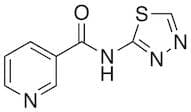
CAS 51987-99-6
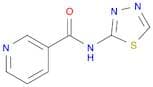
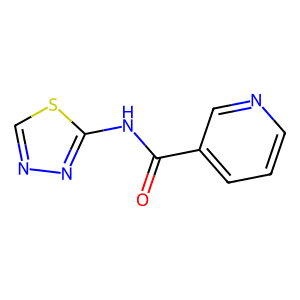
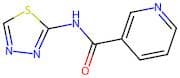
:N-(1,3,4-Thiadiazolyl)nicotinamide
CAS:Formula:C8H6N4OSPurity:98%Color and Shape:SolidMolecular weight:206.2244N-(1,3,4-Thiadiazol-2-Yl)Nicotinamide
CAS:N-(1,3,4-Thiadiazol-2-Yl)NicotinamidePurity:99%Molecular weight:206.22g/molTGN-020
CAS:TGN-020 is an inhibitor of Aquaporin 4 (AQP4, IC50: 3.1 μM), the most abundant water channel in the brain.Formula:C8H6N4OSPurity:99.54% - 99.99%Color and Shape:SolidMolecular weight:206.22N-(1,3,4-Thiadiazolyl)nicotinamide
CAS:Controlled ProductApplications A thiadiazole derivative as antitumor agent.
References Papadopoulos, M., et al.: J. Biol. Chem., 280, 13906 (2005), Gao, J., et al.: Anal. Biochem., 350, 165 (2006), Huber, V., et al.: Bioorg. Med. Chem., 17, 418 (2009),Formula:C8H6N4OSColor and Shape:Off White SolidMolecular weight:206.22N-(1,3,4-Thiadiazolyl)nicotinamide
CAS:N-(1,3,4-Thiadiazolyl)nicotinamide is an intracellular drug that inhibits the release of a growth factor, which may be involved in the development of migraine. It has been shown to inhibit the activity of the enzyme VEGF and reduces infarction volume in rats. N-(1,3,4-Thiadiazolyl)nicotinamide also has a neuroprotective effect by reducing reactive astrocytes and inhibiting fibrillary acidic protein expression in the cerebral cortex of rats. This drug is osmotically active and can induce neuronal damage due to brain swelling. N-(1,3,4-Thiadiazolyl)nicotinamide is also used as a stain for neurons in histological studies.
Formula:C8H6N4OSPurity:Min. 95%Molecular weight:206.22 g/mol