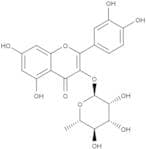
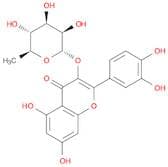
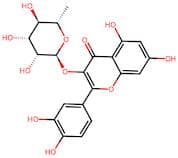
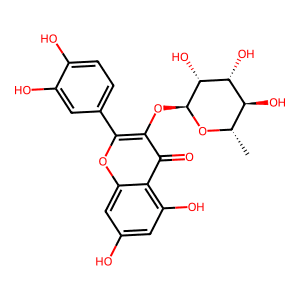
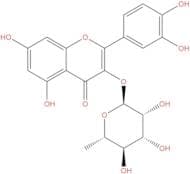
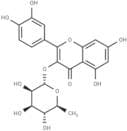
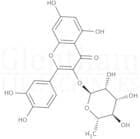
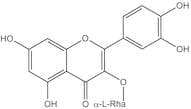
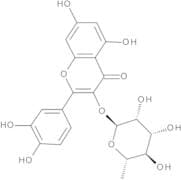
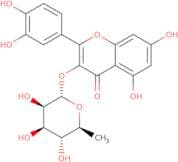
CAS 522-12-3
:Quercitrin
- 3,3',4',5,7-Pentahydroxyflavone 3-L-rhamnoside
- 3,3′,4′,5,7-Pentahydroxyflavone 3-α-<span class="text-smallcaps">L</span>-rhamnoside
- 3-O-Rhamnosylquercetin
- 3-O-α-<span class="text-smallcaps">L</span>-Rhamnopyranosylquercetin
- 3-[(6-Deoxy-α-<span class="text-smallcaps">L</span>-mannopyranosyl)oxy]-2-(3,4-dihydroxyphenyl)-5,7-dihydroxy-4H-1-benzopyran-4-one
- 3-[(6-Desoxy-α-L-mannopyranosyl)oxy]-2-(3,4-dihydroxyphenyl)-5,7-dihydroxy-4H-benzopyran-4-on
- 3-[(6-deoxy-α-L-mannopyranosyl)oxy]-2-(3,4-dihydroxyphenyl)-5,7-dihydroxy-4H-benzopyran-4-one
- 3-[(6-desoxi-α-L-manopiranosil)oxi]-2-(3,4-dihidroxifenil)-5,7-dihidroxi-4H-benzopirano-4-ona
- 3-[(6-desoxy-α-L-mannopyrannosyl)oxy]-2-(3,4-dihydroxyphenyl)-5,7-dihydroxy-4H-benzopyranne-4-one
- 4H-1-Benzopyran-4-one, 3-[(6-deoxy-α-<span class="text-smallcaps">L</span>-mannopyranosyl)oxy]-2-(3,4-dihydroxyphenyl)-5,7-dihydroxy-
- 5,7,3',4'-Tetrahydroxyflavonol 3-O-rhamnoside
- 5,7,3′,4′-Tetrahydroxyflavone 3-O-α-<span class="text-smallcaps">L</span>-rhamnoside
- Nsc 9221
- Quercetin 3-L-rhamnoside
- Quercetin 3-O-L-rhamnoside
- Quercetin 3-O-rhamnopyranoside
- Quercetin 3-O-rhamnoside
- Quercetin 3-O-α-<span class="text-smallcaps">L</span>-rhamnopyranoside
- Quercetin 3-O-α-<span class="text-smallcaps">L</span>-rhamnoside
- Quercetin 3-O-α-L-rhamnopyranoside
- Quercetin 3-O-α-L-rhamnoside
- Quercetin 3-O-α-rhamnopyranoside
- Quercetin 3-rhamnopyranoside
- Quercetin 3-rhamnoside
- Quercetin 3-α-<span class="text-smallcaps">L</span>-rhamnoside
- Quercetin 3-α-rhamnoside
- Quercetin rhamnoside
- Quercetin-3-O-α-rhamnoside
- Quercimelin
- Quercitrin
- Quercitroside
- Wa 17779
- 3-[(6-Deoxy-Alpha-L-Mannopyranosyl)Oxy]-2-(3,4-Dihydroxyphenyl)-5,7-Dihydroxy-4H-Benzopyran-4-One
- 2-(3,4-dihydroxyphenyl)-5,7-dihydroxy-4-oxo-4H-chromen-3-yl 6-deoxy-alpha-L-galactopyranoside
- 2-(3,4-dihydroxyphenyl)-5,7-dihydroxy-4-oxo-4H-chromen-3-yl 6-deoxy-alpha-L-mannopyranoside
- 2-(3,4-dihydroxyphenyl)-5,7-dihydroxy-4-oxo-4H-chromen-3-yl (5xi)-6-deoxy-alpha-L-lyxo-hexopyranoside
- 4H-1-Benzopyran-4-one, 3-[(6-deoxy-α-L-mannopyranosyl)oxy]-2-(3,4-dihydroxyphenyl)-5,7-dihydroxy-
- 3-[(6-Deoxy-α-L-mannopyranosyl)oxy]-2-(3,4-dihydroxyphenyl)-5,7-dihydroxy-4H-1-benzopyran-4-one
- C.I. 75720
- 3,3′,4′,5,7-Pentahydroxyflavone 3-α-L-rhamnoside
- See more synonyms
Quercitrin
CAS:Quercitrin analytical standard provided with w/w absolute assay, to be used for quantitative titration.Formula:C21H20O11Purity:(HPLC) ≥98%Color and Shape:PowderMolecular weight:448.38Quercetin 3-O-rhamnoside
CAS:Formula:C21H20O11Purity:98%Color and Shape:SolidMolecular weight:448.37692-(3,4-Dihydroxyphenyl)-5,7-Dihydroxy-3-(((2S,3R,4R,5R,6S)-3,4,5-Trihydroxy-6-Methyltetrahydro-2H-Pyran-2-Yl)Oxy)-4H-Chromen-4-One
CAS:2-(3,4-Dihydroxyphenyl)-5,7-Dihydroxy-3-(((2S,3R,4R,5R,6S)-3,4,5-Trihydroxy-6-Methyltetrahydro-2H-Pyran-2-Yl)Oxy)-4H-Chromen-4-OnePurity:98%Molecular weight:448.38g/molQuercitrin
CAS:Quercetin is a common antioxidant flavonoid found in vegetables, which is usually present in glycosylated forms, such as quercitrin (3-rhamnosylquercetin), has anti-inflammatory effect which is mediated through the inhibition of the NF-kappaB pathway, inhibits cytokine and inducible nitric oxide synthase expression through inhibition of the NF-kappaB pathway without modification of c-Jun N-terminal kinase activity (both in vitro and in vivo).Formula:C21H20O11Purity:95%~99%Color and Shape:Yellow powderMolecular weight:448.38Quercitrin
CAS:Quercitrin (3-rhamnosyl quercetin) is a plant-derived flavonoid compound, displays antioxidant and anti-inflammatory activities.Formula:C21H20O11Purity:98.89% - 99.66%Color and Shape:Yellow Crystals From Dil Methanol Or Ethanol SolidMolecular weight:448.38Quercetin 3-a-L-rhamnoside
CAS:Formula:C21H20O11Purity:≥ 98.0%Color and Shape:White to yellow crystalline powderMolecular weight:448.38Quercitrin
CAS:Natural glycosideFormula:C21H20O11Purity:≥ 95.0 % (HPLC)Color and Shape:PowderMolecular weight:448.38Quercitrin
CAS:Controlled ProductStability Hygroscopic
Applications Quercitrin is known as an bio flavonoid antioxidant and was investigated extensively in its antioxidant potential in streptrozotocin (STZ)-induced diabetic rats. Quercitrin is also a constituent of the dye quercitron. Quercitrin can be found in Tartary buckwheat and in oaks species such as white oak or European red oak.
References Babujanarthanam, R., et al.: Mol. Cell. Biochem. 358, 121 (2011); Sanders, R.A., et al.: J. Biochem. Mol. Toxicol.,15, 143 (2001); Pavlisic, B., et al.: Tekstilec., 54, 69 (2011);Formula:C21H20O11Color and Shape:Light Yellow To Dark YellowMolecular weight:448.38Quercetin 3-α-L-rhamnoside
CAS:Quercetin 3-α-L-rhamnoside is a flavonoid compound, which is a plant-derived product with rich biological activity. It is primarily sourced from various fruits and vegetables, where it occurs naturally as a glycoside. The mode of action involves its capability to modulate oxidative stress and inflammation through interactions with several cellular pathways, primarily by acting as an antioxidant and modulating enzyme activity related to reactive oxygen species.
Formula:C21H20O11Purity:Min. 95%Color and Shape:White PowderMolecular weight:448.38 g/molRef: 3D-MQ08116
Discontinued product