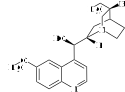
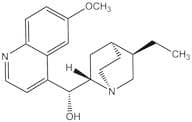
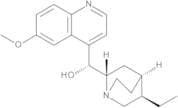
CAS 522-66-7
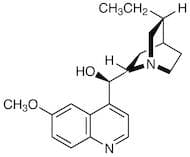
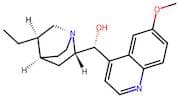
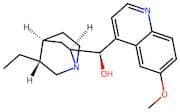
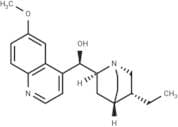
:(-)-Dihydroquinine
- 10,11-Dihydroquinine
- Hydroquinine
- Dihydroquinine
- Cinchonan-9-ol, 10,11-dihydro-6′-methoxy-, (8α,9R)-
- (8α,9R)-10,11-Dihydro-6′-methoxycinchonan-9-ol
(-)-Dihydroquinine
CAS:Formula:C20H26N2O2Purity:>95.0%(T)(HPLC)Color and Shape:White to Light yellow powder to crystalMolecular weight:326.44Dihydroquinine (R-[(2S,4S,5R)-5-Ethylquinuclidin-2-yl](6-methoxyquinolin-4-yl)methanol)
CAS:Alkaloids of cinchona (excluding quinine and its salts) and their derivatives; salts thereofFormula:C20H26N2O2Color and Shape:Off-White SolidMolecular weight:326.19943(1R)-((2S,4S,5R)-5-Ethyl-quinuclidine-2-yl)(6-methoxy-quinolin-4-yl)methanol
CAS:Formula:C20H26N2O2Purity:95%Color and Shape:SolidMolecular weight:326.4326(-)-Dihydroquinine
CAS:(-)-DihydroquinineFormula:C20H26N2O2Purity:98%Color and Shape: white to gray solidMolecular weight:326.43g/molHydroquinine
CAS:Hydroquinine, is an organic compound and as a cinchona alkaloid closely related to quinine.Formula:C20H26N2O2Purity:99.42%Color and Shape:SolidMolecular weight:326.43(-)-dihydroquinine
CAS:Cinchona alkaloidFormula:C20H26N2O2Purity:≥ 95.0 % (HPLC)Color and Shape:PowderMolecular weight:326.44Hydroquinine
CAS:Hydroquinine is a quinidine derivative that is used in the treatment of malaria, as well as cardiac and infectious diseases. It is also used to measure the concentration of hydroquinine in urine. Hydroquinine inhibits the production of dopamine, which is necessary for the transmission of impulses in the central nervous system. This drug has been shown to have both atrial and ventricular effects, with an increased risk of cardiac arrhythmias. Hydroquinine can be used in chemical inhibition studies because it can bind to a variety of ligands, such as dihydroquinidine and papillary muscle.
Formula:C20H26N2O2Purity:Min. 95%Color and Shape:Off-White PowderMolecular weight:326.43 g/mol(1R)-((2S,4S,5R)-5-Ethylquinuclidin-2-yl)(6-methoxyquinolin-4-yl)methanol
CAS:Formula:C20H26N2O2Purity:95%Color and Shape:Beige powderMolecular weight:326.44(-)-Dihydroquinine
CAS:Controlled ProductApplications (-)-Dihydroquinine, is a dihydro derivative of Quinine (Q694000), having antipyretic (fever-reducing), antimalarial, analgesic (painkilling), and anti-inflammatory properties.
References Muhtadi, F.J., et al.: Anal. Profiles Drug Subs., 12, 547 (1983); Kremsner, P.G., et al.: J. Infect. Dis., 169, 467 (1994);Formula:C20H26N2O2Color and Shape:NeatMolecular weight:326.43