CAS 52204-65-6
:4-propylcyclohexan-1-ol
Description:
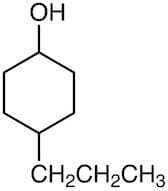
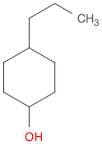
4-Propylcyclohexan-1-ol is an organic compound characterized by a cyclohexane ring with a propyl group and a hydroxyl (-OH) group attached to it. The presence of the hydroxyl group classifies it as an alcohol, which contributes to its polar nature and potential for hydrogen bonding. This compound typically exhibits a colorless to pale yellow liquid form at room temperature and has a relatively low volatility due to its larger molecular structure compared to simpler alcohols. Its molecular structure allows for various conformations, influencing its physical properties such as boiling point and solubility. 4-Propylcyclohexan-1-ol is expected to be soluble in organic solvents and may have limited solubility in water due to the hydrophobic cyclohexane ring. It can be used in various applications, including as a solvent, in organic synthesis, or as an intermediate in the production of other chemical compounds. Safety data should be consulted for handling and storage, as with all chemical substances.
Formula:C9H18O
InChI:InChI=1/C9H18O/c1-2-3-8-4-6-9(10)7-5-8/h8-10H,2-7H2,1H3
SMILES:CCCC1CCC(CC1)O
Synonyms:- 4-n-Propylcyclohexanol
- 4-Propylcyclohexanol
Sort by
Purity (%)
0
100
|
0
|
50
|
90
|
95
|
100
Found 5 products.
4-Propylcyclohexanol (cis- and trans- mixture)
CAS:Formula:C9H18OPurity:>98.0%(GC)Color and Shape:Colorless to Almost colorless clear liquidMolecular weight:142.244-Propylcyclohexan-1-ol
CAS:4-Propylcyclohexan-1-olPurity:95%Color and Shape:LiquidMolecular weight:142.24g/mol4-Propylcyclohexanol
CAS:Formula:C9H18OPurity:≥98%(GC)Color and Shape:Liquid, ClearMolecular weight:142.2424-Propylcyclohexan-1-ol
CAS:4-Propylcyclohexan-1-ol is a liquid crystal that has been shown to be an activator of eugenol. It is a reactive intermediate in the reaction with bond cleavage. It has been shown to have a kinetic rate that is dependent on the number of carbon walls and metal ions. 4-Propylcyclohexan-1-ol can cause dehydration (loss of water) and detergent compositions can be made using it as a functional group. The hydroxyl group present in this molecule, combined with its functional groups, makes this liquid crystal useful for the production of polymers and plastics. This monomer can also polymerize into polyesters, polyamides, or polyurethanes.
Formula:C9H18OPurity:Min. 95%Molecular weight:142.24 g/mol