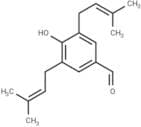
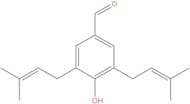
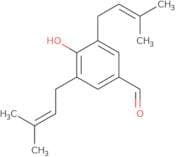
![4-hydroxy-3,5-bis[(1E)-3-methylbut-1-en-1-yl]benzaldehyde](/_next/image/?url=https%3A%2Fstatic.cymitquimica.com%2Fcas-image%2Fthumb-webp%2F174087-4-hydroxy-35-bis-1e-3-methylbut-1-en-1-yl-benzaldehyde.webp&w=3840&q=75)
CAS 52275-04-4
:4-hydroxy-3,5-bis[(1E)-3-methylbut-1-en-1-yl]benzaldehyde
Description:
4-Hydroxy-3,5-bis[(1E)-3-methylbut-1-en-1-yl]benzaldehyde, with the CAS number 52275-04-4, is an organic compound characterized by its aromatic structure featuring a benzaldehyde functional group and two substituents derived from 3-methylbut-1-ene. This compound exhibits properties typical of phenolic aldehydes, including potential antioxidant activity due to the presence of the hydroxyl group. The presence of the bulky alkyl substituents can influence its solubility and reactivity, making it less polar compared to simpler aldehydes. It may also exhibit interesting biological activities, which could be attributed to its structural features. The compound's synthesis typically involves multi-step organic reactions, and it may be of interest in fields such as medicinal chemistry or materials science. Its stability, reactivity, and potential applications would depend on the specific conditions under which it is handled, including temperature, pH, and the presence of catalysts or other reagents. Overall, this compound represents a unique structure that could be explored for various chemical and biological applications.
Formula:C17H22O2
InChI:InChI=1/C17H22O2/c1-12(2)5-7-15-9-14(11-18)10-16(17(15)19)8-6-13(3)4/h5-13,19H,1-4H3/b7-5+,8-6+
Sort by
Purity (%)
0
100
|
0
|
50
|
90
|
95
|
100
Found 4 products.
3,5-Diprenyl-4-hydroxybenzaldehyde
CAS:3,5-Diprenyl-4-hydroxybenzaldehyde is a natural product for research related to life sciences. The catalog number is TN2901 and the CAS number is 52275-04-4.Formula:C17H22O2Purity:98%Color and Shape:SolidMolecular weight:258.363,5-Diprenyl-4-hydroxybenzaldehyde
CAS:Formula:C17H22O2Purity:95%~99%Color and Shape:PowderMolecular weight:258.3613,5-Diprenyl-4-hydroxybenzaldehyde
CAS:3,5-Diprenyl-4-hydroxybenzaldehyde is a phenolic compound, which is isolated as a secondary metabolite primarily from plants such as the Anacardiaceae and Leguminosae families. This compound serves as part of the plant's defense mechanism. It exerts its mode of action through various biochemical pathways, including antioxidant and antimicrobial activities, by interfering with cellular redox states and disrupting microbial cell walls or metabolic processes.Formula:C17H22O2Purity:Min. 95%Molecular weight:258.35 g/mol