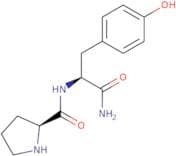
CAS 52329-46-1
:L-Tyrosinamide, L-prolyl-
Description:
L-Tyrosinamide, L-prolyl- is a dipeptide derivative formed from the amino acids L-tyrosine and L-proline. It is characterized by its structure, which includes an amide bond linking the two amino acid residues. This compound is typically white to off-white in appearance and is soluble in water, reflecting the polar nature of its constituent amino acids. L-Tyrosinamide, L-prolyl- may exhibit biological activity, potentially influencing various physiological processes due to the roles of its parent amino acids in protein synthesis and neurotransmitter function. The compound is of interest in biochemical research and may have applications in pharmaceuticals or as a biochemical probe. Its stability, solubility, and reactivity can vary depending on environmental conditions such as pH and temperature. As with many peptides, it is important to handle it with care, considering potential allergenic responses or interactions with other biochemical substances. Further studies may be required to fully elucidate its properties and potential applications in various fields.
Formula:C14H19N3O3
Sort by
Purity (%)
0
100
|
0
|
50
|
90
|
95
|
100
Found 1 products.
H-Pro-Tyr-NH2·HCl
CAS:Noopept is a peptide-like nootropic drug that belongs to the group of analogs of proline. It has been shown to have neuroprotective and cognitive enhancing effects in animal studies, as well as an antipsychotic effect. Noopept is a competitive antagonist of the glutamate receptor, and also has affinity for dopamine and serotonin receptors. Noopept is taken orally and penetrates into the brain quickly, where it interacts with different types of neurotransmitter systems. It also shows translational activity in vitro (in cell culture) and in vivo (in animals). This substance can be detected in human blood plasma following oral administration.Formula:C14H19N3O3·HClPurity:Min. 95%Molecular weight:313.78 g/mol