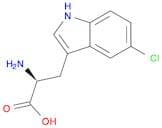
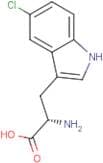
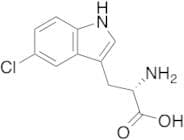
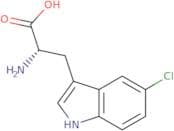
CAS 52448-15-4
:5-Chloro-L-tryptophan
- L-Tryptophan, 5-chloro-
- 5-Chloro-L-tryptophan
- (S)-2-Amino-3-(5-chloro-1H-indol-3-yl)propanoic acid
(S)-2-AMINO-3-(5-CHLORO-1H-INDOL-3-YL)-PROPIONIC ACID
CAS:Formula:C11H11ClN2O2Purity:98%Color and Shape:SolidMolecular weight:238.6702(S)-2-Amino-3-(5-chloro-1H-indol-3-yl)propanoic Acid
CAS:Controlled ProductStability Hygroscopic
Applications (S)-2-Amino-3-(5-chloro-1H-indol-3-yl)propanoic acid (cas# 52448-15-4) is a useful research chemical.Formula:C11H11N2O2ClColor and Shape:NeatMolecular weight:238.675-Chloro-L-tryptophan
CAS:5-Chloro-L-tryptophan (5CTP) is a chemical compound that belongs to the class of cyclic peptides. It is biosynthesized by plants and other organisms from 4-chloro-L-tryptophan. 5CTP is synthesized from 4CTP by a two step process, involving an oxidative decarboxylation followed by a deamination reaction. The oxidative decarboxylation converts the amino acid into an intermediate, which is then deaminated and converted into 5CTP. This compound has been shown to have potential as a drug against cancer cells, with its mechanism of action being related to its ability to form metal chelates with heavy metals such as copper and mercury. 5CTP has also been used in molecular modeling studies, genetic analyses, and biochemical investigations of substrate binding and enzyme catalysis.
Formula:C11H11N2O2ClPurity:Min. 95%Color and Shape:White PowderMolecular weight:238.67 g/mol5-Chloro-L-tryptophan
CAS:5-Chloro-L-tryptophan is a reactive component that is used as a reagent to synthesize other compounds. It is also used as a building block for the synthesis of complex molecules and as an intermediate in the production of L-DOPA, which is used to treat Parkinson's disease. 5-Chloro-L-tryptophan can be used as a versatile building block in organic synthesis. This chemical has shown high reactivity with nucleophiles and has been shown to react with amino groups, hydroxyl groups, and thiols. 5-Chloro-L-tryptophan has many applications including research chemicals, pharmaceuticals, agrochemicals, dyes, and photographic chemicals.
Formula:C11H11ClN2O2Purity:Min. 97 Area-%Molecular weight:238.67 g/molRef: 3D-W-202973
1gTo inquire5gTo inquire10gTo inquire500mgTo inquire2500mgTo inquire-Unit-ggTo inquire