CAS 52448-16-5
:4-Bromo-L-tryptophan
Description:
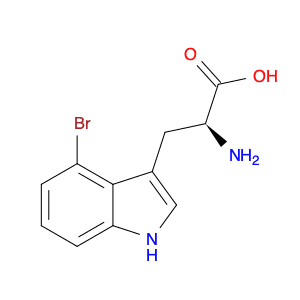
4-Bromo-L-tryptophan is an amino acid derivative characterized by the presence of a bromine atom at the fourth position of the indole ring of L-tryptophan. This compound is a halogenated analog of the essential amino acid tryptophan, which plays a crucial role in protein synthesis and serves as a precursor for neurotransmitters such as serotonin. The introduction of the bromine atom can influence the compound's biochemical properties, potentially affecting its reactivity, solubility, and interaction with biological systems. 4-Bromo-L-tryptophan is often utilized in biochemical research to study protein structure and function, as well as in the synthesis of various pharmaceuticals. Its molecular structure includes a carboxylic acid group, an amino group, and the indole side chain, contributing to its classification as a polar, hydrophilic compound. Safety data indicates that, like many halogenated compounds, it should be handled with care due to potential toxicity and environmental impact.
Formula:C11H11BrN2O2
InChI:InChI=1S/C11H11BrN2O2/c12-7-2-1-3-9-10(7)6(5-14-9)4-8(13)11(15)16/h1-3,5,8,14H,4,13H2,(H,15,16)/t8-/m0/s1
InChI key:InChIKey=OFKIVYVSESEHFZ-QMMMGPOBSA-N
SMILES:C([C@@H](C(O)=O)N)C=1C=2C(NC1)=CC=CC2Br
Synonyms:- (2S)-2-Amino-3-(4-bromo-1H-indol-3-yl)propanoic acid
- L-Tryptophan, 4-bromo-
- (S)-2-Amino-3-(4-bromo-1H-indol-3-yl)propanoic acid
- 4-Bromo-L-tryptophan
- (S)-2-Amino-3-(4-bromo-1H-indol-3-yl)propanoicacid
Sort by
Purity (%)
0
100
|
0
|
50
|
90
|
95
|
100
Found 4 products.
4-BROMO-L-TRYPTOPHAN
CAS:Formula:C11H11BrN2O2Purity:95%Color and Shape:SolidMolecular weight:283.12124-Bromo-L-tryptophan
CAS:4-Bromo-L-tryptophan is an amino acid that is used in the synthesis of biomimetic molecules. It is synthesized by allylation with bromine and then chromatographically purified. 4-Bromo-L-tryptophan can also be used to study the biosynthesis of tryptophan. 4-Bromo-L-tryptophan has a molecular weight of 204.2 daltons and a pKa of 5.72, which makes it acidic at physiological pH values. The compound spontaneously forms anhydride with hydroxytryptophan, which stabilizes it and prevents hydrolysis reactions. The optimum temperature for enzymatic activity is 160 degrees Celsius, and kinetic constants have been determined at this temperature as well as at 100 degrees Celsius. Catalytic asymmetric synthesis has also been accomplished using 4-bromo L tryptophan as a substrate.Formula:C11H11BrN2O2Purity:Min. 95%Color and Shape:Slightly Yellow PowderMolecular weight:283.12 g/mol(S)-2-Amino-3-(4-bromo-1H-indol-3-yl)propanoic acid
CAS:Formula:C11H11BrN2O2Purity:97%Color and Shape:SolidMolecular weight:283.125