CAS 52462-29-0
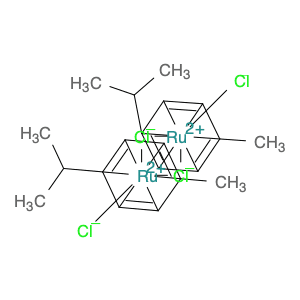
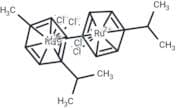
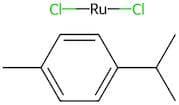
:Bis(dichloro(η6-p-cymene)ruthenium)
Description:
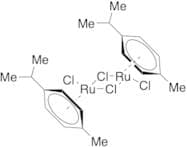
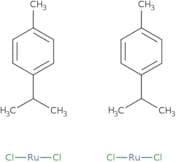
Bis(dichloro(η6-p-cymene)ruthenium) is a coordination compound featuring ruthenium as the central metal atom, coordinated to two dichloro(η6-p-cymene) ligands. This compound is characterized by its unique structure, where the p-cymene ligand, a substituted aromatic hydrocarbon, binds to the ruthenium center in a η6 fashion, indicating that the entire aromatic ring is involved in coordination. The dichloro groups contribute to the overall stability and reactivity of the complex. Typically, such ruthenium complexes exhibit interesting catalytic properties, particularly in organic transformations and polymerization reactions. They may also show potential in medicinal chemistry, especially in cancer treatment, due to their ability to interact with biological molecules. The compound is generally handled with care due to the presence of chlorine, which can be toxic. Its solubility in organic solvents and stability under various conditions make it a subject of interest in both academic and industrial research. Overall, bis(dichloro(η6-p-cymene)ruthenium) exemplifies the versatility of transition metal complexes in coordination chemistry.
Formula:C20H28Cl4Ru2
InChI:InChI=1S/2C10H14.4ClH.2Ru/c2*1-8(2)10-6-4-9(3)5-7-10;;;;;;/h2*4-8H,1-3H3;4*1H;;/q;;;;;;2*+2/p-4
InChI key:InChIKey=LAXRNWSASWOFOT-UHFFFAOYSA-J
SMILES:[Cl-][Ru+2]123456(C=7(C(C)C)[CH]1=[CH]2C3(C)=[CH]4[CH]57)[Cl-][Ru+2]89%10%11%12([Cl-])([Cl-]6)C=%13(C(C)C)[CH]8=[CH]9C%10(C)=[CH]%11[CH]%12%13
Synonyms:- (Cymene)ruthenium dichloride dimer
- (p-Cymene)ruthenium dichloride dimer
- (p-Cymene)ruthenium(II) chloride dimer
- Benzene, 1-methyl-4-(1-methylethyl)-, ruthenium complex
- Bis(((η6-4-isopropyltoluene)(chloro)(μ-chloro)ruthenium))
- Bis(((η<sup>6</sup>-4-isopropyltoluene)(chloro)(μ-chloro)ruthenium))
- Bis((dichloro(η6-p-isopropyl(methyl)benzene)ruthenium))
- Bis((dichloro(η<sup>6</sup>-p-isopropyl(methyl)benzene)ruthenium))
- Bis((η6-p-cymene)dichlororuthenium)
- Bis((η<sup>6</sup>-p-cymene)dichlororuthenium)
- Bis((μ-chloro)chloro(η6-1-isopropyl-4-methylbenzene)ruthenium)
- Bis((μ-chloro)chloro(η6-4-isopropyltoluene)ruthenium)
- Bis((μ-chloro)chloro(η<sup>6</sup>-1-isopropyl-4-methylbenzene)ruthenium)
- Bis((μ-chloro)chloro(η<sup>6</sup>-4-isopropyltoluene)ruthenium)
- Bis(4-isopropyltoluene)tetrachlorodiruthenium
- Bis(chloro(μ-chloro)(η6-p-cymene)ruthenium)
- Bis(chloro(μ-chloro)(η6-p-isopropyl(methyl)benzene)ruthenium)
- Bis(chloro(μ-chloro)(η6-p-isopropyltoluene)ruthenium)
- Bis(chloro(μ-chloro)(η<sup>6</sup>-p-cymene)ruthenium)
- Bis(chloro(μ-chloro)(η<sup>6</sup>-p-isopropyl(methyl)benzene)ruthenium)
- Bis(chloro(μ-chloro)(η<sup>6</sup>-p-isopropyltoluene)ruthenium)
- Bis(dichloro(p-η6-isopropyltoluene)ruthenium)
- Bis(dichloro(p-η<sup>6</sup>-isopropyltoluene)ruthenium)
- Bis(dichloro(η6-4-isopropyltoluene)ruthenium)
- Bis(dichloro(η6-p-cymene)ruthenium)
- Bis(dichloro(η6-p-isopropyltoluene)ruthenium)
- Bis(dichloro(η<sup>6</sup>-4-isopropyltoluene)ruthenium)
- Bis(dichloro(η<sup>6</sup>-p-cymene)ruthenium)
- Bis(dichloro(η<sup>6</sup>-p-isopropyltoluene)ruthenium)
- Bis(p-cymene)diruthenium(II) tetrachloride
- Bis(η6-p-Cymene)tetrachlorodiruthenium
- Bis(η<sup>6</sup>-p-Cymene)tetrachlorodiruthenium
- Bis(μ-chlorochloro(η6-4-cymene)ruthenium)
- Bis(μ-chlorochloro(η<sup>6</sup>-4-cymene)ruthenium)
- Bis[(η6-p-isopropyltoluene)dichlororuthenium]
- Bis[(η<sup>6</sup>-1-isopropyl-4-methylbenzene)dichlororuthenium]
- Bis[(η<sup>6</sup>-p-isopropyltoluene)dichlororuthenium]
- Bis[dichlorido(cym) ruthenium(II)]
- Bis[dichloro(1-isopropyl-4-methylbenzene)ruthenium]
- Bis[dichloro(p-cymene)ruthenium]
- Bis[dichloro(η6-1-isopropyl-4-methylbenzene)ruthenium]
- Bis[dichloro(η<sup>6</sup>-1-isopropyl-4-methylbenzene)ruthenium]
- Di-chlorobis[(p-cymene)chlororuthenium(II)]
- Di-micron-chlorobis(p-cymene)chlororuthenium(II)
- Di-μ-chlorobis(chloro(η6-4-cymene)ruthenium)
- Di-μ-chlorobis(chloro(η6-4-isopropyltoluene)ruthenium)
- Di-μ-chlorobis(chloro(η6-p-cymene)ruthenium)
- Di-μ-chlorobis(chloro(η<sup>6</sup>-4-cymene)ruthenium)
- Di-μ-chlorobis(chloro(η<sup>6</sup>-4-isopropyltoluene)ruthenium)
- Di-μ-chlorobis(chloro(η<sup>6</sup>-p-cymene)ruthenium)
- Di-μ-chlorobis[(p-cymene)chlororuthenium(II)]
- Di-μ-chlorobis[(p-cymene)chlororuthenium]
- Di-μ-chlorodichlorobis(η<sup>5</sup>-1-isopropyl-4-methylbenzene)diruthenium
- Di-μ-chlorodichlorobis(η<sup>6</sup>-p-cymene)diruthenium
- Di-μ-chlorodichlorobis[(1,2,3,4,5,6-η)-1-methyl-4-(1-methylethyl)benzene]diruhtenium
- Di-μ-chlorodichlorobis[(1,2,3,4,5,6-η)-1-methyl-4-(1-methylethyl)benzene]diruthenium
- Dichloro(p-cymene)ruthenium dimer
- Dichloro(p-cymene)ruthenium(II) dimer
- Dichlorobis(p-cymene)ruthenium(II)-dimer
- DichlorobispcymenechlororutheniumIImin
- Dichlorodi-μ-chlorobis(η6-4-isopropyltoluene)diruthenium
- Dichlorodi-μ-chlorobis(η<sup>6</sup>-4-isopropyltoluene)diruthenium
- Ruthenium 120
- Ruthenium(2+) Chloride-1-Methyl-4-(Propan-2-Yl)Benzene (1:2:1)
- Ruthenium, di-μ-chlorodichlorobis[(1,2,3,4,5,6-η)-1-methyl-4-(1-methylethyl)benzene]di-
- Tetrachlorobis(4-cymene)diruthenium
- Tetrachlorobis(4-cymene)diruthenium(II)
- Tetrachlorobis(4-isopropyltoluene)diruthenium
- Tetrachlorobis(mu-4-cymene)diruthenium(II)
- Tetrachlorobis(p-cymene)diruthenium
- Tetrachlorobis(η6-cymene)diruthenium
- Tetrachlorobis(η6-p-cymene)diruthenium
- Tetrachlorobis(η<sub>6</sub>-cymene)diruthenium
- Tetrachlorobis(η<sup>6</sup>-p-cymene)diruthenium
- [Ru(p-cymene)Cl2]2
- [Ru(p-cymene)Cl<sub>2</sub>]<sub>2</sub>
- See more synonyms
Sort by
Purity (%)
0
100
|
0
|
50
|
90
|
95
|
100
Found 11 products.
Dichloro(p-cymene)ruthenium(II) Dimer
CAS:Formula:C20H28Cl4Ru2Purity:>95.0%(T)Color and Shape:Light yellow to Brown powder to crystalMolecular weight:612.38Dichloro(p-cymene)ruthenium(II) dimer, 98%
CAS:Dichloro(p-cymene)ruthenium(II) dimer is used as hydrosilylation catalyst and also used as a pharmaceutical intermediate. This Thermo Scientific Chemicals brand product was originally part of the Alfa Aesar product portfolio. Some documentation and label information may refer to the legacy brand. ThFormula:C20H28Cl4Ru2Purity:98%Color and Shape:powder, Orange-red to red-brownMolecular weight:612.38Di-μ-chlorobis[(p-cymene)chlororuthenium(II)], min. 98%
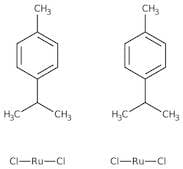
CAS:Di-μ-chlorobis[(p-cymene)chlororuthenium(II)], min. 98%
Formula:RuCl2(C10H14)Purity:min. 98%Color and Shape:brown pwdr.Molecular weight:612.39Dichloro(p-cymene)ruthenium(II) dimer
CAS:Formula:C20H28Cl4Ru2Purity:97%Color and Shape:SolidMolecular weight:612.3883Dichloro(p-cymene)ruthenium(II) Dimer
CAS:Dichloro(p-cymene)ruthenium(II) Dimer is an organometallic ruthenium complex, a widely used catalyst in various organic reactions
Formula:C20H28Cl4Ru2Color and Shape:SolidMolecular weight:612.39Dichloro(p-cymene)ruthenium(II) dimer
CAS:Dichloro(p-cymene)ruthenium(II) dimerFormula:·2Cl2Ru·2C10H14Purity:98%Color and Shape: red solidMolecular weight:612.38832g/molDichloro(p-cymene)ruthenium(II) dimer
CAS:Dichloro(p-cymene)ruthenium(II) dimerFormula:·Cl2Ru·C10H14Purity:98%Color and Shape: red to reddish brown solidMolecular weight:306.19g/molDichloro(p-cymene)ruthenium(II)dimer
CAS:Formula:C20H28Cl4Ru2Purity:97%Color and Shape:Crystalline Powder,PowderMolecular weight:612.38Dichloro(p-cymene)ruthenium(II) Dimer
CAS:Controlled ProductApplications The dichloro(p-cymene)ruthenium(II) dimer is a reagent used in organometallic chemistry, and usually adopts the “three-leg-piano-stool” geometry. The dichloro(p-cymene)ruthenium(II) dimer, when functionalized with di- or tripyridyl aromatic ether ligands, creates di- and three trinuclear organometallic complexes that act as antiparasitic agents.
References Chellan. P., et al.: Organometallics, 32, 4793 (2013); Grguric-Sipka, S., et al.: Eur. J. Med. Chem., 45, 1051 (2010)Formula:C20H28Cl4Ru2Color and Shape:NeatMolecular weight:612.39Dichloro(p-cymene)ruthenium(II) dimer
CAS:Dichloro(p-cymene)ruthenium(II) dimer is an organometallic compound that is used as a catalyst in organic synthesis. It is a square planar molecule with a hydroxyl group at the center. The carbon atoms are bound to two dichloro pyridine ligands and two ruthenium atoms. Dichloro(p-cymene)ruthenium(II) dimer has been shown to be effective for the treatment of trichomonas vaginalis, cancer, and other diseases. This drug also has an amide ligand and a chelate ring that make it chemically stable in acidic environments. Dichloro(p-cymene)ruthenium(II) dimer is activated by amines in the presence of oxygen or hydrogen peroxide, which leads to its decomposition into dichloro pyridine and ruthenium dioxide.Formula:C20H28Cl4Ru2Purity:Min. 95%Color and Shape:Red PowderMolecular weight:612.39 g/mol



![Di-μ-chlorobis[(p-cymene)chlororuthenium(II)], min. 98%](/_next/image/?url=https%3A%2Fstatic.cymitquimica.com%2Fproducts%2F08%2Fthumb%2F44-0190.jpg&w=3840&q=75)