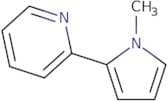
CAS 525-75-7
:2-(1-Methyl-1H-pyrrol-2-yl)pyridine
Description:
2-(1-Methyl-1H-pyrrol-2-yl)pyridine, with the CAS number 525-75-7, is an organic compound characterized by its unique structure, which features a pyridine ring substituted with a 1-methyl-1H-pyrrole group. This compound typically exhibits a pale yellow to brownish color and is soluble in organic solvents, reflecting its non-polar characteristics. It has a molecular formula that includes both nitrogen-containing heterocycles, which contribute to its potential biological activity. The presence of the pyridine and pyrrole moieties suggests that it may engage in various chemical interactions, including hydrogen bonding and π-π stacking, making it of interest in medicinal chemistry and materials science. Additionally, this compound may exhibit properties such as fluorescence or photostability, depending on its environment. Its applications could range from serving as a ligand in coordination chemistry to being a precursor in the synthesis of more complex organic molecules. As with many nitrogen-containing compounds, it may also display interesting pharmacological properties, warranting further investigation.
Formula:C10H10N2
InChI:InChI=1S/C10H10N2/c1-12-8-4-6-10(12)9-5-2-3-7-11-9/h2-8H,1H3
InChI key:InChIKey=YRMIZZHAGCDHTG-UHFFFAOYSA-N
SMILES:CN1C(=CC=C1)C2=CC=CC=N2
Synonyms:- 1-Methyl-2-(2-pyridyl)pyrrole
- 2-(1-Methyl-1H-pyrrol-2-yl)pyridine
- 2-(1-Methyl-2-pyrryl)pyridine
- Pyridine, 2-(1-methyl-1H-pyrrol-2-yl)-
- Pyridine, 2-(1-methylpyrrol-2-yl)-
- α-Nicotyrine
Sort by
Purity (%)
0
100
|
0
|
50
|
90
|
95
|
100
Found 1 products.
2-(1-Methyl-1H-pyrrol-2-yl)pyridine
CAS:2-(1-Methyl-1H-pyrrol-2-yl)pyridine is an acidic, pharmacokinetic, and reactive chemical. It is a postulated carcinogen that may also have neurotoxic effects. 2-(1-Methyl-1H-pyrrol-2-yl)pyridine has been shown to inhibit the synthesis of prostaglandin E2 in animals. The biochemical mechanism of inhibition is not yet known, but it may be due to the formation of reactive radicals such as pyrrole. This chemical can be metabolized into 2-(1-methylpyrrolidinium) sulfamate by microsomes in animals. The sulfamate form can also undergo diode reactions with other compounds.Formula:C10H10N2Purity:Min. 95%Molecular weight:158.2 g/mol