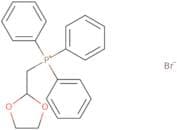
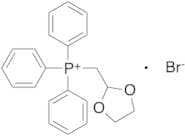
CAS 52509-14-5
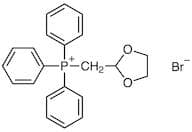
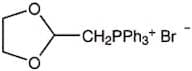
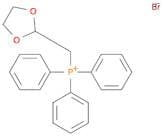
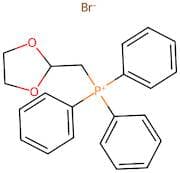
:(1,3-Dioxolan-2-ylmethyl)triphenylphosphonium bromide
Description:
(1,3-Dioxolan-2-ylmethyl)triphenylphosphonium bromide is a quaternary ammonium salt characterized by its triphenylphosphonium cation and a dioxolane moiety. This compound typically appears as a white to off-white solid and is soluble in polar organic solvents, which facilitates its use in various chemical reactions. The presence of the dioxolane ring contributes to its stability and reactivity, making it a useful intermediate in organic synthesis, particularly in the formation of carbon-carbon bonds. The triphenylphosphonium group enhances lipophilicity, allowing for better membrane permeability in biological systems. Additionally, the bromide anion serves as a counterion, which can influence the compound's reactivity and solubility. This substance is often utilized in synthetic organic chemistry, including applications in the synthesis of phosphonium ylides and other derivatives. Safety precautions should be observed when handling this compound, as with many organophosphorus compounds, due to potential toxicity and reactivity.
Formula:C22H22BrO2P
InChI:InChI=1/C22H22O2P.BrH/c1-4-10-19(11-5-1)25(18-22-23-16-17-24-22,20-12-6-2-7-13-20)21-14-8-3-9-15-21;/h1-15,22H,16-18H2;1H/q+1;/p-1
InChI key:InChIKey=FRHRVQQUICVJDG-UHFFFAOYSA-M
SMILES:[P+](CC1OCCO1)(C2=CC=CC=C2)(C3=CC=CC=C3)C4=CC=CC=C4.[Br-]
Synonyms:- (1,3-Dioxolane-2-Yl Methyl) Triphenyl Phosphonium Bromide
- 1,3-Dioxylany-2-yl)triphenylphosphonium bromide
- 2-[(1,3)-Dioxolane-2-Yl]-Methyltriphenylphosphonium Bromide
- Labotest-Bb Lt00233112
- Phosphonium, (1,3-Dioxolan-2-Ylmethyl)Triphenyl-, Bromide
- Phosphonium, (1,3-dioxolan-2-ylmethyl)triphenyl-, bromide (1:1)
- Triphenyl-1,3-Dioxolan-2-Ylmethyl-Phosphonium Bromide
- [(1,3-Dioxolan-2-yl)methyl]triphenylphosphanium bromide
- (1,3-Dioxolan-2-ylmethyl)triphenylphosphonium bromide
- (1,3-Dioxolan-2-ylmethyl)triphenylphosphonium bromide, 98 %
- 1,3-Dioxolan-2-ylmethyl-triphenylphosphanium bromide
- (1,3-DIOXOLAN-2-YLMETHYL)TRIPHENYLPHOSPHONIUM BROMIDE 98%
- See more synonyms
Sort by
Purity (%)
0
100
|
0
|
50
|
90
|
95
|
100
Found 8 products.
(1,3-Dioxolan-2-yl)methyltriphenylphosphonium Bromide
CAS:Formula:C22H22BrO2PPurity:>97.0%(T)Color and Shape:White to Light yellow to Light orange powder to crystalMolecular weight:429.29(1,3-Dioxolan-2-ylmethyl)triphenylphosphonium bromide, 98%
CAS:It finds its applications as a reagent for Wittig olefinations with introduction of a 1,3-dioxolane moiety. It is applied as a reactant for the preparation of a ratiometric fluorescent probe for specific detection of cysteine over homocysteine and glutathione, for microwave-assisted synthesis of KN-Formula:C22H22BrO2PPurity:98%Color and Shape:White to cream, Crystals or powder or crystalline powderMolecular weight:429.29(1,3-Dioxolan-2-ylmethyl)triphenylphosphonium bromide
CAS:Formula:C22H22BrO2PPurity:97%Color and Shape:SolidMolecular weight:429.2866(1,3-Dioxolan-2-ylmethyl)(triphenyl)phosphonium bromide
CAS:(1,3-Dioxolan-2-ylmethyl)(triphenyl)phosphonium bromideFormula:C22H22O2P·BrPurity:98%Color and Shape: off-white solidMolecular weight:429.29g/mol(1,3-Dioxolan-2-yl)methyltriphenylphosphonium Bromide
CAS:(1,3-Dioxolan-2-yl)methyltriphenylphosphonium Bromide is a synthetic reagent that is used in the Wittig reaction. It is prepared by reacting p-toluenesulfonic acid with methylene chloride and methoxybenzene. This reagent can be used to synthesize β-unsaturated aldehydes from alkenes and hydroxylamine. The preparation of this reagent involves recrystallizing it from ethanol or ethyl acetate and then hydrogenating it to give (1,3-dioxolan-2-yl)methyl triphenylphosphonium bromide.Formula:C22H22BrO2PPurity:Min. 95%Color and Shape:PowderMolecular weight:429.29 g/mol(1,3-Dioxolan-2-ylmethyl)triphenylphosphonium bromide
CAS:Formula:C22H22BrO2PPurity:97%Color and Shape:Solid, PowderMolecular weight:429.294(1,3-Dioxolan-2-ylmethyl)triphenylphosphonium Bromide
CAS:Controlled ProductApplications (1,3-Dioxolan-2-ylmethyl)triphenylphosphonium Bromide is used as a reactant in the synthesis of ketolides methyloxoerythromycins with antibacterial activity as highly potent against macrolide-resistant and susceptible respiratory pathogens.
References Agouridas, C., et al.: J. Med. Chem., 41, 4080 (1998);Formula:C22H22O2P·BrColor and Shape:NeatMolecular weight:429.3