CAS 526-86-3
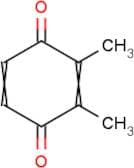
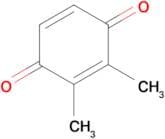
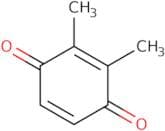
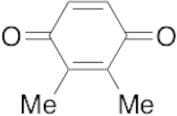
:2,3-Dimethyl-2,5-cyclohexadiene-1,4-dione
- 2,3-Dimethyl-1,4-benzoquinone
- 2,3-Dimethyl-2,5-cyclohexadiene-1,4-dione
- 2,3-Dimethyl-p-benzoquinone
- 2,3-Dimethyl-p-quinone
- 2,3-Dimethylbenzoquinone
- 2,3-Dimethylquinone
- 2,5-Cyclohexadiene-1,4-Dione, 2,3-Dimethyl-
- NSC 402192
- o-Xyloquinone
- p-Benzoquinone, 2,3-dimethyl-
2,3-dimethyl-2,5-cyclohexadiene-1,4 dione
CAS:Formula:C8H8O2Purity:95%Color and Shape:SolidMolecular weight:136.14792,3-DIMETHYL-2,5-CYCLOHEXADIENE-1,4 DIONE
CAS:Purity:95.0%Color and Shape:SolidMolecular weight:136.149993896484382,3-Dimethyl-2,5-cyclohexadiene-1,4 dione
CAS:2,3-Dimethyl-2,5-cyclohexadiene-1,4 dione (DMX) is an antioxidant that has been shown to be effective in the reaction of transfer reactions. DMX has been shown to have a binding constant with fatty acids and is able to inhibit bacterial enzymes such as cytochrome P450s. DMX also reacts with hydroxide solution and forms a salt that can be used as an inhibitor molecule for redox potential. This salt can easily be dissolved in water and is stable at high temperatures. It is possible for DMX to react with molecular modelling software in order to find the optimal reaction conditions for this compound.
Formula:C8H8O2Purity:Min. 95%Color and Shape:PowderMolecular weight:136.15 g/mol2,3-Dimethylbenzoquinone
CAS:Controlled ProductApplications 2,3-Dimethylbenzoquinone is a reagent in the preparation of hydroxycinnolines which has antifungal activity.
References Ryu, C., et al.: Bioorg. Med. Chem. Lett., 16, 1850 (2006)Formula:C8H8O2Color and Shape:NeatMolecular weight:136.15