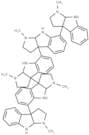
CAS 52617-25-1
:3a(1H),7′:3′a,3′′a(1′H,1′′H):7′′,3′′′a(1′′′H):7′′′,3′′′′a(1′′′′H)-Quinquepyrrolo[2,3-b]indole, 2,2′,2′′,2′′′,2′′′′,3,3′,3′′,3′′′,3′′′′,8,8′,8′′,8′′′,8′′′′,8a,8′a,8′′a,8′′′a,8′′′′a-eicosahydro-1,1′,1′′,1′′′,1′′′′-pentamethyl-, (3aR,3′aS,3′′aR,3′′′aR,3′′′′aR,8aR,8′aS,8′′aR,8′′′aR,8′′′′aR)-
Description:
The chemical substance known as 3a(1H),7′:3′a,3′′a(1′H,1′′H):7′′,3′′′a(1′′′H):7′′′,3′′′′a(1′′′′H)-Quinquepyrrolo[2,3-b]indole, with the CAS number 52617-25-1, is a complex organic compound characterized by its intricate polycyclic structure. This substance features multiple fused pyrrole rings, contributing to its unique electronic properties and potential biological activity. The stereochemistry of the compound is specified by its chiral centers, which can influence its reactivity and interactions with biological systems. Typically, such compounds may exhibit interesting pharmacological properties, making them subjects of research in medicinal chemistry. The presence of multiple methyl groups suggests a degree of hydrophobicity, which can affect solubility and permeability in biological membranes. Overall, the structural complexity and stereochemical configuration of this compound may lead to diverse applications in drug development and materials science, although specific biological activities would require further empirical investigation.
Formula:C55H62N10
InChI:InChI=1S/C55H62N10/c1-61-28-23-51(33-13-6-8-21-41(33)56-46(51)61)35-15-10-16-36-43(35)58-48-53(36,25-30-63(48)3)38-18-12-20-40-45(38)60-50-55(40,27-32-65(50)5)54-26-31-64(4)49(54)59-44-37(17-11-19-39(44)54)52-24-29-62(2)47(52)57-42-22-9-7-14-34(42)52/h6-22,46-50,56-60H,23-32H2,1-5H3/t46-,47-,48-,49+,50-,51-,52-,53-,54-,55+/m1/s1
InChI key:InChIKey=DVJSMVZSIBHXAO-CSZYDKBHSA-N
SMILES:CN1[C@@]2([C@@](C=3C(N2)=C(C=CC3)[C@@]45C=6C(N[C@@]4(N(C)CC5)[H])=C(C=CC6)[C@@]78C=9C(N[C@@]7(N(C)CC8)[H])=CC=CC9)(CC1)[C@]%10%11C=%12C(N[C@]%10(N(C)CC%11)[H])=C(C=CC%12)[C@@]%13%14C=%15C(N[C@@]%13(N(C)CC%14)[H])=CC=CC%15)[H]
Synonyms:- Pyrrolo[2,3-b]indole, psychotridine deriv.
- 3a(1H),7′:3′a,3′′a(1′H,1′′H):7′′,3′′′a(1′′′H):7′′′,3′′′′a(1′′′′H)-Quinquepyrrolo[2,3-b]indole, 2,2′,2′′,2′′′,2′′′′,3,3′,3′′,3′′′,3′′′′,8,8′,8′′,8′′′,8′′′′,8a,8′a,8′′a,8′′′a,8′′′′a-eicosahydro-1,1′,1′′,1′′′,1′′′′-pentamethyl-, (3aR,3′aS,3′′aR,3′′′aR,3′′′′aR,8aR,8′aS,8′′aR,8′′′aR,8′′′′aR)-
- Psychotridine
- (-)-Psychotridine
Sort by
Purity (%)
0
100
|
0
|
50
|
90
|
95
|
100
Found 2 products.
Psychotridine
CAS:Psychotridine, an alkaloid in P. forsteriana, inhibits platelet aggregation and is cytotoxic to HTC cells; reduces capsaicin-induced pain in mice.Formula:C55H62N10Color and Shape:SolidMolecular weight:863.171Psychotridine
CAS:Psychotridine is an alkaloid compound, which is naturally derived from certain plant species known for their medicinal properties. This compound is primarily extracted from the genus Psychotria, a group of flowering plants belonging to the Rubiaceae family. The mode of action of psychotridine involves interaction with the central nervous system, where it may influence neurotransmitter pathways. While the exact mechanism remains under investigation, it appears to exhibit affinity for certain neuronal receptors, potentially modulating neurochemical transmission and influencing synaptic plasticity.
Formula:C55H62N10Purity:Min. 95%Molecular weight:863.10 g/mol