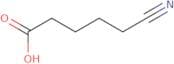
CAS 5264-33-5
:5-cyanopentanoic acid
Description:
5-Cyanopentanoic acid, with the CAS number 5264-33-5, is an organic compound characterized by its carboxylic acid functional group and a cyano group attached to a five-carbon alkane chain. This compound typically appears as a colorless to pale yellow liquid or solid, depending on its physical state at room temperature. It is soluble in polar solvents such as water and alcohols, owing to the presence of the carboxylic acid group, which can engage in hydrogen bonding. The cyano group contributes to its reactivity, making it a useful intermediate in organic synthesis, particularly in the production of pharmaceuticals and agrochemicals. The presence of both the carboxylic acid and cyano functionalities allows for a range of chemical transformations, including esterification and nucleophilic addition reactions. Additionally, 5-cyanopentanoic acid may exhibit moderate toxicity, necessitating appropriate safety precautions during handling and use. Overall, its unique structure and functional groups make it a valuable compound in various chemical applications.
Formula:C6H9NO2
InChI:InChI=1/C6H9NO2/c7-5-3-1-2-4-6(8)9/h1-4H2,(H,8,9)
InChI key:InChIKey=SKUPALMUTWEAPI-UHFFFAOYSA-N
SMILES:C(CC(O)=O)CCC#N
Synonyms:- 5-Cyanovaleric acid
- Pentanoic Acid, 5-Cyano-
- Valeric acid, 5-cyano-
- 5-Cyanopentanoic acid
Sort by
Purity (%)
0
100
|
0
|
50
|
90
|
95
|
100
Found 3 products.
5-Cyanopentanoic acid
CAS:5-Cyanopentanoic acid is an activating reagent that is used in the oxidation of alcohols and amines. It reacts with aldehydes, ketones, nitriles, and esters to form carboxylic acids. 5-Cyanopentanoic acid can also be used to form acyl cyanides from aldehydes and acetals. This substance inhibits microbial growth by reacting with the amino groups on microbial cell surfaces. 5-Cyanopentanoic acid has been shown to react with nucleophiles such as methyl alcohol or carbamic acid to form a bidentate ligand. The reaction mechanism for this process is similar to that of a nucleophile attacking an electrophile.END>
Formula:C6H9NO2Purity:Min. 95%Molecular weight:127.14 g/mol