CAS 52645-73-5
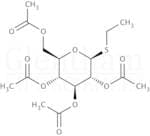
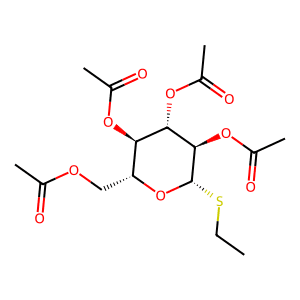
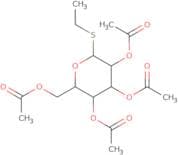
:b-D-Glucopyranoside, ethyl1-thio-, 2,3,4,6-tetraacetate
Description:
β-D-Glucopyranoside, ethyl 1-thio-, 2,3,4,6-tetraacetate is a glycoside derivative of glucose, characterized by the presence of a thioether group and multiple acetyl groups. This compound features a pyranose ring structure, which is typical for sugars, and the ethyl thio group enhances its reactivity and solubility in organic solvents. The tetraacetate moiety indicates that four hydroxyl groups of the glucose unit are acetylated, which can influence the compound's stability, reactivity, and biological activity. Such modifications often enhance lipophilicity and can affect the compound's interaction with biological systems, making it of interest in various fields, including medicinal chemistry and biochemistry. The compound is typically used in synthetic organic chemistry as an intermediate or as a building block for more complex molecules. Its CAS number, 52645-73-5, allows for easy identification and retrieval of information regarding its properties and applications in chemical databases.
Formula:C16H24O9S
Synonyms:- Ethyl 2,3,4,6-Tetra-O-Acetyl-1-Thio-Beta-D-Glucopyranoside
Sort by
Purity (%)
0
100
|
0
|
50
|
90
|
95
|
100
Found 5 products.
Ethyl 2,3,4,6-tetra-o-acetyl-α-d-thioglucopyranoside
CAS:Formula:C16H24O9SPurity:97%Color and Shape:SolidMolecular weight:392.4214Ethyl 2,3,4,6-tetra-O-acetyl-1-thio-β-D-glucopyranoside
CAS:Ethyl 2,3,4,6-tetra-O-acetyl-1-thio-β-D-glucopyranosidePurity:98%Molecular weight:392.42g/molEthyl 2,3,4,6-tetra-O-acetyl-b-D-thioglucopyranoside
CAS:Polyimides are polymers that are used in a variety of industrial and consumer products. Ethyl 2,3,4,6-tetra-O-acetyl-b-D-thioglucopyranoside is a type of polyimide that has been shown to be photosynthetic. Polyimides are synthesized by condensing acetylene with formaldehyde in the presence of an acid catalyst. This compound has been investigated for use as an active component in photonic and optoelectronic devices such as solar cells and light emitting diodes (LEDs). The material is also being explored for use in the fabrication of microelectronic devices such as field effect transistors (FETs) and optical switches. It can be used to investigate organisms’ photosynthetic activity qualitatively or quantitatively by observing color changes or measuring oxygen production.Formula:C16H24O9SPurity:Min. 95%Color and Shape:White PowderMolecular weight:392.5 g/mol