CAS 52691-62-0
:1-O-Hexadecyl-sn-glycero-3-phosphocholine
Description:
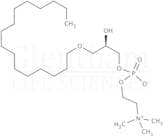
1-O-Hexadecyl-sn-glycero-3-phosphocholine, commonly referred to as DHPC, is a synthetic phospholipid that plays a significant role in membrane biology and biochemistry. It features a long-chain fatty acid (hexadecyl) attached to the glycerol backbone, which contributes to its amphiphilic nature, allowing it to interact with both hydrophilic and hydrophobic environments. The presence of a phosphocholine head group enhances its solubility in aqueous solutions and facilitates interactions with biological membranes. DHPC is often utilized in the formation of liposomes and lipid bilayers, serving as a model for studying membrane dynamics and properties. Its structural characteristics enable it to stabilize membrane structures and influence membrane fluidity. Additionally, DHPC is used in various applications, including drug delivery systems and as a component in biochemical assays. Its unique properties make it a valuable tool in both research and therapeutic contexts, particularly in the study of cell membrane interactions and lipid-based formulations.
Formula:C24H52NO6P
InChI:InChI=1/C24H52NO6P/c1-5-6-7-8-9-10-11-12-13-14-15-16-17-18-20-29-22-24(26)23-31-32(27,28)30-21-19-25(2,3)4/h24,26H,5-23H2,1-4H3/t24-/m1/s1
InChI key:InChIKey=VLBPIWYTPAXCFJ-XMMPIXPASA-N
SMILES:O(C[C@@H](COCCCCCCCCCCCCCCCC)O)P(OCC[N+](C)(C)C)(=O)[O-]
Synonyms:- (R)-3-(Hexadecyloxy)-2-hydroxypropyl (2-(trimethylammonio)ethyl) phosphate
- 1-Hexadecyl-2-lyso-sn-glycero-3-phosphocholine
- 1-O-Hexadecyl-2-lyso-sn-glycero-3-phosphocholine
- 1-O-Hexadecyl-sn-glycero-3-phosphatidylcholine
- 1-O-Hexadecyl-sn-glycero-3-phosphocholine
- 1-O-Hexadecyl-sn-glyceryl-3-phosphorylcholine
- 3,5,9-Trioxa-4-phosphapentacosan-1-aminium, 4,7-dihydroxy-N,N,N-trimethyl-, inner salt, 4-oxide, (7R)-
- 3,5,9-Trioxa-4-phosphapentacosan-1-aminium, 4,7-dihydroxy-N,N,N-trimethyl-, inner salt, 4-oxide, (R)-
- 58: PN: WO2017201317 SEQID: 131 claimed RNA
- Lpc O-16:0
- Lyso-platelet-activating factor
- 1-Hexadecyl-sn-glycero-3-phosphocholine, 3-sn-Lysophosphatidylcholine, 1-hexadecyl, Lyso-PAF-C16, Lyso-platelet activating factor
- 1-hexadecyl
- L -ALPHA-LYSOPHOSPHATIDYL- CHOLINE-GAMMA-O-HEXADECYL 99%
- GAMMA-O-HEXADECYL L-A-LYSOPHOSPHATIDYLCHOLINE
- 1-O-hexadecyl-2-lyso-glycero-3-phosphorylcholine
- Lyso-PAF (C16),98%
- 1-O-HEXADECYL-2-HYDROXY-SN-GLYCERO-3-PHOSPHOCHOLINE
- 1-O-Alkyl-sn-glycero-3-phosphocholine, Lyso-platelet activating factor
- LYSO-PAF (C16)
- L-A-LYSOPHOSPHATIDYLCHOLINE, GAMMA-O-*HE XADECYL
- L-ALPHA-LYSOPHOSPHATIDYLCHOLINE, GAMMA-O-HEXADECYL
- LYSO PAF[C16] (L-A-LYSOPHOSPHATIDYLCHOLI NBE, GAMMA-O-HEXADECYL)
- LYSO-PAF16
- LYSO-PLATELET ACTIVATING FACTOR (C16)
- 1-hexadecyl-sn-glycero-3-phosphocholine
- LYSO-PLATELET ACTIVATING FACTOR-16
- L-ALPHA-PHOSPHATIDYLCHOLINE-GAMMA-O-HEXADECYL
- 1-O-Alkyl-sn-glycero-3-phosphocholine
- 1-O-HEXADECYL-SN-GLYCERO-3-PHOSPHORYLCHOLINE
- 1-O-PALMITYL-SN-GLYCERO-3-PHOSPHOCHOLINE
- γ-O-Alkyl-L-α-lysophosphatidylcholine from bovine heart
- C16 LYSO PAF
- See more synonyms
Sort by
Purity (%)
0
100
|
0
|
50
|
90
|
95
|
100
Found 5 products.
1-O-Hexadecyl-sn-glycero-3-phosphocholine
CAS:Bachem ID: 4008363.
Formula:C24H52NO6PPurity:> 98%Molecular weight:481.653,5,9-Trioxa-4-phosphapentacosan-1-aminium,4,7-dihydroxy-N,N,N-trimethyl-, inner salt, 4-oxide, (7R)-
CAS:Formula:C24H52NO6PPurity:98%Molecular weight:481.6465Lyso-PAF C-16
CAS:Lyso-PAF C-16 is a substrate for PAF C-16, also obtainable via enzymatic acylation of arachidonic acid, suitable for biochemical experiments.Formula:C24H52NO6PColor and Shape:White SolidMolecular weight:481.651-O-Hexadecyl-sn-glycero-3-phosphocholine
CAS:1-O-Hexadecyl-sn-glycero-3-phosphocholine (1OHDGPC) is a compound that inhibits the uptake of oxidized LDL in neuronal cells and reduces neuronal death. 1OHDGPC also has antihypertensive activity, as it decreases systolic blood pressure. This compound is an antioxidant because it prevents the oxidation of LDL cholesterol, which is the main cause of atherosclerosis. 1OHDGPC has been shown to reduce the incidence of allergic reactions in animal studies. It also has been shown to have hydroxyl groups and fatty acid chains, which may contribute to its antioxidant properties.Formula:C24H52NO6PColor and Shape:PowderMolecular weight:481.65 g/mol