CAS 52744-22-6
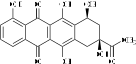
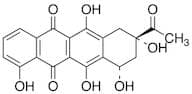
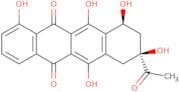
:(8S,10S)-8-acetyl-1,6,8,10,11-pentahydroxy-7,8,9,10-tetrahydrotetracene-5,12-dione
Description:
The chemical substance known as "(8S,10S)-8-acetyl-1,6,8,10,11-pentahydroxy-7,8,9,10-tetrahydrotetracene-5,12-dione," with the CAS number 52744-22-6, is a complex organic compound characterized by its polycyclic structure, which includes multiple hydroxyl groups and a diketone functionality. This compound features a tetracene backbone, which is a series of four fused benzene rings, contributing to its potential electronic and optical properties. The presence of acetyl and hydroxyl groups suggests that it may exhibit interesting reactivity and solubility characteristics, making it potentially useful in various applications, including organic electronics, dyes, or as a precursor in synthetic chemistry. Its stereochemistry, indicated by the (8S,10S) configuration, implies specific spatial arrangements that could influence its biological activity or interaction with other molecules. Overall, this compound represents a fascinating area of study within organic chemistry, particularly in the context of functional materials and their applications.
Formula:C20H16O8
InChI:InChI=1/C20H16O8/c1-7(21)20(28)5-9-13(11(23)6-20)19(27)15-14(17(9)25)16(24)8-3-2-4-10(22)12(8)18(15)26/h2-4,11,22-23,25,27-28H,5-6H2,1H3/t11-,20-/m0/s1
SMILES:CC(=O)[C@@]1(Cc2c([C@H](C1)O)c(c1c(C(=O)c3cccc(c3C1=O)O)c2O)O)O
Sort by
Purity (%)
0
100
|
0
|
50
|
90
|
95
|
100
Found 4 products.
4-Demethyl Daunomycinone
CAS:Applications A metabolite Daunorubicin in liver microsomes.
References Ogawa, Y., et al.: J. Antibiotics, 37, 44 (1984), Schwartz, H.S., et al.: Cancer Res., 44, 2480 (1984), Burke, T.G., et al.: Biochemistry, 24, 1768 (1985),Formula:C20H16O8Color and Shape:RedMolecular weight:384.344-Demethyl daunomycinone
CAS:4-Demethyl daunomycinone is an anthracycline derivative, which is a natural or semi-synthetic compound derived from the bacterium *Streptomyces*. It is primarily studied for its potential use in anticancer therapies, given its structural similarity to other well-known anthracyclines like daunorubicin and doxorubicin. These compounds are known to intercalate into DNA, thereby disrupting the function of DNA and RNA synthesis, leading to the inhibition of cell proliferation.Formula:C20H16O8Purity:Min. 95%Molecular weight:384.34 g/mol