CAS 52784-31-3
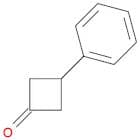
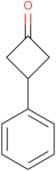
:3-phenylcyclobutanone
Description:
3-Phenylcyclobutanone is a cyclic ketone characterized by a cyclobutane ring substituted with a phenyl group and a carbonyl functional group. Its molecular structure features a four-membered ring, which contributes to its unique reactivity and physical properties. The presence of the phenyl group enhances its aromatic characteristics, influencing its stability and potential interactions in chemical reactions. Typically, 3-phenylcyclobutanone exhibits a solid state at room temperature and has a relatively low melting point, indicative of its molecular interactions. This compound is of interest in organic synthesis and medicinal chemistry due to its potential applications in the development of pharmaceuticals and agrochemicals. Its reactivity can be attributed to the strained cyclobutane ring, which may undergo various transformations, including ring-opening reactions. Additionally, the compound's properties, such as solubility and volatility, can vary based on the solvent and environmental conditions. Overall, 3-phenylcyclobutanone serves as a valuable building block in synthetic organic chemistry, offering diverse pathways for further functionalization and application.
Formula:C10H10O
InChI:InChI=1/C10H10O/c11-10-6-9(7-10)8-4-2-1-3-5-8/h1-5,9H,6-7H2
SMILES:c1ccc(cc1)C1CC(=O)C1
Sort by
Purity (%)
0
100
|
0
|
50
|
90
|
95
|
100
Found 4 products.
3-PHENYL-CYCLOBUTAN-1-ONE
CAS:Formula:C10H10OPurity:98%Color and Shape:LiquidMolecular weight:146.18583-Phenylcyclobutan-1-one
CAS:3-Phenylcyclobutan-1-oneFormula:C10H10OPurity:92%Color and Shape: yellow low melting solidMolecular weight:146.19g/mol3-Phenylcyclobutanone
CAS:3-Phenylcyclobutanone is a hydrogen peroxide that is used as an oxidizing agent in organic synthesis. It has been shown to be a more powerful oxidant than benzoyl peroxide and can be used to produce the ring-opening of cyclobutanones. This compound has been shown to have antimicrobial properties against microbial strains such as Escherichia coli, Bacillus subtilis, and Streptococcus pneumoniae. 3-Phenylcyclobutanone may also be reduced by sodium borohydride to form cyclobutanone, which is chiral with a molecular ion mass of 162.
Formula:C10H10OPurity:Min. 95%Molecular weight:146.19 g/mol