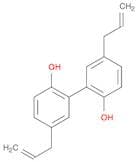
CAS 528-43-8
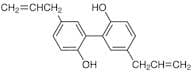
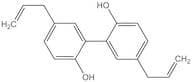
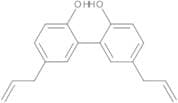
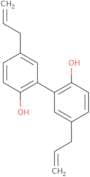
:Magnolol
Description:
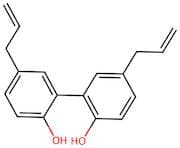
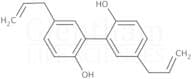
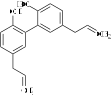
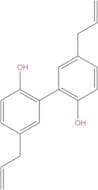
Magnolol is a natural compound primarily derived from the bark of the Magnolia tree, particularly from species such as Magnolia officinalis. It is classified as a biphenolic compound, characterized by its two aromatic rings connected by a carbon chain. Magnolol exhibits a range of biological activities, including anti-inflammatory, antioxidant, and antimicrobial properties, making it of interest in pharmacological research. The substance is typically a white to pale yellow crystalline solid with a melting point that varies depending on purity and specific conditions. It is soluble in organic solvents like ethanol and methanol but has limited solubility in water. Magnolol has been studied for its potential therapeutic effects, including its role in anxiety reduction and its ability to enhance cognitive function. Additionally, it is being explored for its potential applications in food preservation and cosmetics due to its antimicrobial properties. Overall, magnolol represents a significant compound in both traditional medicine and modern scientific research.
Formula:C18H18O2
InChI:InChI=1/C18H18O2/c1-3-5-13-7-9-17(19)15(11-13)16-12-14(6-4-2)8-10-18(16)20/h3-4,7-12,19-20H,1-2,5-6H2
InChI key:InChIKey=VVOAZFWZEDHOOU-UHFFFAOYSA-N
SMILES:OC=1C(=CC(CC=C)=CC1)C2=CC(CC=C)=CC=C2O
Synonyms:- 2,2′-Bichavicol
- 2,2′-Biphenyldiol, 5,5′-diallyl-
- 2-(2-Hydroxy-5-prop-2-enylphenyl)-4-prop-2-enylphenol
- 5,5'-Di(Prop-2-En-1-Yl)Biphenyl-2,2'-Diol
- 5,5′-Di-2-propen-1-yl[1,1′-biphenyl]-2,2′-diol
- 5,5′-Diallyl-2,2′-biphenyldiol
- Magnolia Extract
- NSC 293099
- [1,1′-Biphenyl]-2,2′-diol, 5,5′-di-2-propen-1-yl-
- [1,1′-Biphenyl]-2,2′-diol, 5,5′-di-2-propenyl-
- Honokiol std.
- MAGNOLOL
- Magnolol std.
- 5',5-di-2-propenyl-(1,1'-Biphenyl)-2,2'-diol
- 5,5'-DIALLYL-BIPHENYL-2,2'-DIOL
- MAGNOLOL(SH)
- 1’-Biphenyl)-2,2’-diol,5’,5-di-2-propenyl-(1
- Magnolia officinalis Rehd.et Wils
- MAGNOLIABARKEXTRACT
- 5,5'-DIALLYL-2,2'-DIHYDROXYBIPHENYL
- MAGNOLOL 98.0% BY HPLC
- See more synonyms
Sort by
Purity (%)
0
100
|
0
|
50
|
90
|
95
|
100
Found 14 products.
Magnolol
CAS:Magnolol analytical standard provided with w/w absolute assay, to be used for quantitative titration.Formula:C18H18O2Purity:(HPLC) ≥99%Color and Shape:PowderMolecular weight:266.34Magnolol
CAS:Magnolol (5,5'-Diallyl-2,2'-biphenyldiol) is a dual agonist of RXRα( EC50=10.4 μM) and PPARγ(EC50=17.7 μM). It blocks TNF-α-induced NF-KB activation.Formula:C18H18O2Purity:99.49% - 99.98%Color and Shape:A Bioactive Compound Found In The Bark Of The Houpu MagnoliaMolecular weight:266.33Magnolol
CAS:Formula:C18H18O2Purity:≥ 97.0% (dried basis)Color and Shape:White to off-white powder or crystalsMolecular weight:266.3Magnolol
CAS:Magnolol is a dual agonist of both RXRα and PPARγ, with EC50 values of 10.4 μM and 17.7 μM, respectively. Magnolol has antifungal, antibacterial, anti-oxidative, antidepressant-like, anti- tumor, and neuroprotective effects, it also prevents skin photoaging in UVB-irradiated hairless mice. Magnolol has a wide spectrum of targets including TNF-α, NF-KB, GSK3β.Formula:C18H18O2Purity:95%~99%Molecular weight:266.34Magnolol
CAS:Formula:C18H18O2Purity:>98.0%(GC)Color and Shape:White to Almost white powder to crystalMolecular weight:266.34Magnolol
CAS:PolyphenolFormula:C18H18O2Purity:≥ 95.0 % (HPLC)Color and Shape:PowderMolecular weight:266.34Magnolol
CAS:Controlled ProductApplications Magnolol is the bioactive phytochemicals found in Magnolia officinalis (1). Magnolol has been used to treat anxiety, cough, headache and allergies (2). It also inhibits tumor necrosis factor-α-*induced ICAM-1 expression in human lung epithelial cells.
Not a dangerous good if item is equal to or less than 1g/ml and there is less than 100g/ml in the package
References (1) Amorati, R., et al.: J Org Chem. (2015) 80:10651-9.(2) Wu, C., et. al.: Inflammation (2014) 37:1957-67Formula:C18H18O2Color and Shape:Off-WhiteMolecular weight:266.33Magnolol
CAS:Magnolol is a bioactive compound, which is a type of lignan extracted from the bark of the magnolia tree, primarily Magnolia officinalis. It exhibits a diverse range of pharmacological activities, primarily attributed to its anti-inflammatory and antioxidant properties. Through the modulation of various signaling pathways, including the NF-κB pathway, magnolol effectively inhibits the activation of inflammatory mediators and scavenges free radicals.Formula:C18H18O2Purity:Min. 95%Color and Shape:PowderMolecular weight:266.33 g/mol5,5′-Diallyl-[1,1′-biphenyl]-2,2′-diol
CAS:Formula:C18H18O2Purity:99%Color and Shape:SolidMolecular weight:266.34












![5,5′-Diallyl-[1,1′-biphenyl]-2,2′-diol](/_next/image/?url=https%3A%2Fstatic.cymitquimica.com%2Fproducts%2F10%2Fthumb%2FF079442.jpg&w=3840&q=75)