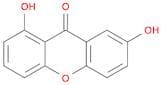
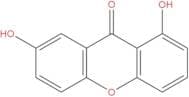
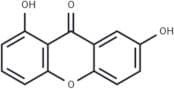
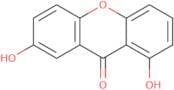
CAS 529-61-3
:Euxanthone
Description:
Euxanthone, with the CAS number 529-61-3, is a naturally occurring xanthone compound primarily derived from various plant sources, particularly from the genus Garcinia. It is characterized by its yellow crystalline appearance and is known for its potential biological activities, including antioxidant, anti-inflammatory, and antimicrobial properties. Euxanthone has a molecular formula that reflects its complex structure, which includes multiple aromatic rings and hydroxyl groups, contributing to its reactivity and solubility in organic solvents. The compound has garnered interest in pharmacological research due to its potential therapeutic applications, particularly in the fields of cancer treatment and neuroprotection. Additionally, its stability and relatively low toxicity make it a subject of study for various industrial applications, including natural dyes and food additives. Overall, euxanthone represents a significant compound in both natural product chemistry and medicinal research, highlighting the importance of plant-derived substances in developing new therapeutic agents.
Formula:C13H8O4
InChI:InChI=1S/C13H8O4/c14-7-4-5-10-8(6-7)13(16)12-9(15)2-1-3-11(12)17-10/h1-6,14-15H
InChI key:InChIKey=KDXFPEKLLFWHMN-UHFFFAOYSA-N
SMILES:O=C1C=2C(OC=3C1=CC(O)=CC3)=CC=CC2O
Synonyms:- 1,7-Dihydroxyxanthone
- 529-61-3
- 9H-Xanthen-9-one, 1,7-dihydroxy-
- Euxanthone
- Xanthen-9-one, 1,7-dihydroxy-
- 1,7-Dihydroxy-9H-xanthen-9-one
Sort by
Purity (%)
0
100
|
0
|
50
|
90
|
95
|
100
Found 5 products.
Euxanthone
CAS:Euxanthone (1,7-Dihydroxyxanthone) from Polygala tenuifolia Willd has neuroprotective and vasorelaxant activities and induces differentiation of BU-1 cells.Formula:C13H8O4Purity:98%Color and Shape:SolidMolecular weight:228.2Euxanthone
CAS:Euxanthone is a natural compound classified as a xanthonoid, which is derived primarily from the resins of specific plant species, notably the Garcinia genus. The compound exhibits a variety of biological activities attributable to its chemical structure, which features a distinctive xanthone core. Euxanthone acts primarily through modulating various enzymatic pathways and interacting with cellular receptors, thereby influencing a range of biological processes including antioxidative and anti-inflammatory responses.
Formula:C13H8O4Purity:Min. 95%Molecular weight:228.2 g/molRef: 3D-AAA52961
Discontinued product