

![2-[(3-carboxypropanoyl)oxy]-N,N,N-trimethylethanaminium](/_next/image/?url=https%3A%2Fstatic.cymitquimica.com%2Fcas-image%2Fthumb-webp%2F397928-2-3-carboxypropanoyl-oxy-n-n-n-trimethylethanaminium.webp&w=3840&q=75)
CAS 5297-17-6
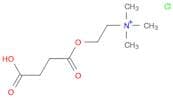
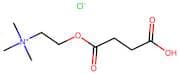
:2-[(3-carboxypropanoyl)oxy]-N,N,N-trimethylethanaminium
- Ethanaminium, 2-(3-carboxy-1-oxopropoxy)-N,N,N-trimethyl-
Succinylmonocholine Chloride
CAS:Quaternary ammonium salts and hydroxides, whether or not chemically defined, nesoiFormula:C9H18ClNO4Color and Shape:White PowderMolecular weight:239.09244Succinylmonocholine Chloride (125 mg)
CAS:Formula:C9H18ClNO4Purity:98%Color and Shape:SolidMolecular weight:239.69652-((3-Carboxypropanoyl)oxy)-N,N,N-trimethylethanaminium chloride
CAS:2-((3-Carboxypropanoyl)oxy)-N,N,N-trimethylethanaminium chloridePurity:98%Molecular weight:239.7g/molSuccinylmonocholine Chloride
CAS:Controlled ProductFormula:C9H18NO4·ClColor and Shape:NeatMolecular weight:239.702-((3-Carboxypropanoyl)oxy)-N,N,N-trimethylethanaminium chloride
CAS:Purity:98%Molecular weight:239.6999969{2-[(3-Carboxypropanoyl)oxy]ethyl}trimethylazanium Chloride
CAS:Formula:C9H18NO4·ClColor and Shape:NeatMolecular weight:239.7{2-[(3-Carboxypropanoyl)oxy]ethyl}trimethylammonium chloride
CAS:Succinylcholine is a depolarizing neuromuscular blocking agent that is used in surgical procedures. Succinylcholine hydrolyzes to succinic acid and choline in vivo and is metabolized by the liver. The half-life of succinylcholine is about 2 minutes in humans. It has been shown that this drug causes respiratory paralysis, but only at high doses. Succinylcholine also has potent cardiac effects, which are due to its ability to block nicotinic acetylcholine receptors on the heart muscle. It was found that succinylmonocholine (a metabolite of succinylcholine) can be detected in urine samples after administration of this drug with a kinetic data analysis method. This method uses LC-MS/MS to measure the concentration of succinylmonocholine in human serum and isolated heart tissue samples. A pharmacokinetic study showed that succinycholines accumulation rate constant was 0.051 ± 0.
Formula:C9H18ClNO4Purity:Min. 95%Molecular weight:239.69 g/mol






![{2-[(3-Carboxypropanoyl)oxy]ethyl}trimethylazanium Chloride](/_next/image/?url=https%3A%2Fstatic.cymitquimica.com%2Fproducts%2FTR%2Fthumb%2FB594105.jpg&w=3840&q=75)

![{2-[(3-Carboxypropanoyl)oxy]ethyl}trimethylammonium chloride](/_next/image/?url=https%3A%2Fstatic.cymitquimica.com%2Fproducts%2F3D%2Fthumb%2FFAA29717.jpg&w=3840&q=75)
