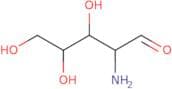
CAS 532-19-4
:Ribosamine
Description:
Ribosamine, with the CAS number 532-19-4, is a chemical compound that is classified as an amino sugar. It is structurally related to ribose, a five-carbon sugar, with an amino group (-NH2) replacing one of the hydroxyl groups. This modification imparts unique properties to ribosamine, making it an important building block in various biological processes. It is involved in the synthesis of nucleotides and nucleic acids, playing a crucial role in cellular metabolism and genetic information transfer. Ribosamine is also known for its potential applications in biochemistry and pharmaceuticals, particularly in the development of antibiotics and other therapeutic agents. The compound is typically characterized by its white crystalline appearance and is soluble in water, which facilitates its biological activity. Its reactivity is influenced by the presence of the amino group, allowing for various chemical modifications that can enhance its functionality in research and medicinal chemistry. Overall, ribosamine is a significant compound in the study of biochemistry and molecular biology.
Formula:C5H11NO4
InChI:InChI=1S/C5H11NO4/c6-3(1-7)5(10)4(9)2-8/h1,3-5,8-10H,2,6H2/t3-,4+,5-/m0/s1
InChI key:InChIKey=RNZJRDIKDNXKIJ-LMVFSUKVSA-N
SMILES:[C@H]([C@H](C=O)N)([C@@H](CO)O)O
Synonyms:- D-Ribose, 2-amino-2-deoxy-
- Ribofuranose, 2-amino-2-deoxy-, D-
- Ribosamine
- 2-Amino-2-deoxy-D-ribose
- D-Ribosamine
Sort by
Purity (%)
0
100
|
0
|
50
|
90
|
95
|
100
Found 2 products.
Ribosamine
CAS:Ribosamine is a medicinal compound that has shown potential as an anticancer agent. It is a kinase inhibitor that targets specific proteins involved in cancer cell growth and survival. Ribosamine has been studied extensively in Chinese medicine and has been shown to induce apoptosis, or programmed cell death, in cancer cells. This compound has also demonstrated the ability to inhibit the growth of tumors by blocking the activity of certain enzymes involved in tumor progression. Ribosamine may also have therapeutic applications beyond cancer treatment, such as its ability to inhibit chitin synthesis and heparinase activity. Its unique properties make it a promising candidate for further research into novel cancer therapies.
Formula:C5H11NO4Purity:Min. 95%Molecular weight:149.15 g/mol