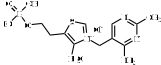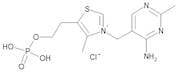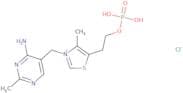
CAS 532-40-1
:Thiamine monophosphate
Description:
Thiamine monophosphate, also known as thiamine phosphate, is a phosphorylated derivative of thiamine (vitamin B1). It is characterized by its role as a coenzyme in various biochemical reactions, particularly in carbohydrate metabolism. The substance is typically a white to off-white crystalline powder that is soluble in water, which facilitates its biological activity. Thiamine monophosphate is essential for the proper functioning of enzymes involved in the decarboxylation of alpha-keto acids and the hexose monophosphate shunt. Its presence is crucial for energy production and the synthesis of neurotransmitters. In terms of stability, thiamine monophosphate is sensitive to heat and alkaline conditions, which can lead to degradation. It is commonly used in dietary supplements and fortification of food products to prevent thiamine deficiency, which can lead to conditions such as beriberi and Wernicke-Korsakoff syndrome. Overall, thiamine monophosphate plays a vital role in maintaining metabolic health and supporting neurological function.
Formula:C12H18ClN4O4PS
InChI:InChI=1/C12H17N4O4PS.ClH/c1-8-11(3-4-20-21(17,18)19)22-7-16(8)6-10-5-14-9(2)15-12(10)13;/h5,7H,3-4,6H2,1-2H3,(H3-,13,14,15,17,18,19);1H
InChI key:InChIKey=GUGWNSHJDUEHNJ-UHFFFAOYSA-N
SMILES:C([N+]=1C(C)=C(CCOP(=O)(O)O)SC1)C=2C(N)=NC(C)=NC2.[Cl-]
Synonyms:- 2-(3-((6-Imino-2-methyl-1,6-dihydropyrimidin-5-yl)methyl)-4-methylthiazol-3-ium-5-yl)ethyl hydrogen phosphate hydrochloride
- 3-[(4-Amino-2-Methylpyrimidin-5-Yl)Methyl]-4-Methyl-5-[2-(Phosphonooxy)Ethyl]-1,3-Thiazol-3-Ium
- 3-[(4-Amino-2-Methylpyrimidin-5-Yl)Methyl]-4-Methyl-5-[2-(Phosphonooxy)Ethyl]-1,3-Thiazol-3-Ium Chloride
- Extraneurina
- Fosbione
- Monophosphothiamine
- Neurifosforil
- Novaneurina
- Novobeta
- Phosbitamin
- Phosphoric acid, thiamine ester
- Phosphothiamin
- Phosphothiamine
- Sineurina
- Superneurina
- TMP (thiamin ester)
- Thiamin monophosphate
- Thiamine monophosphate
- Thiamine monophosphate chloride
- Thiamine phosphate
- Thiamine phosphoric acid ester chloride
- Thiamine, dihydrogen phosphate (ester)
- Thiamine-P
- Thiazolium, 3-[(4-amino-2-methyl-5-pyrimidinyl)methyl]-4-methyl-5-[2-(phosphonooxy)ethyl]-, chloride
- Thiazolium, 3-[(4-amino-2-methyl-5-pyrimidinyl)methyl]-4-methyl-5-[2-(phosphonooxy)ethyl]-, chloride (1:1)
- Vitamin B1 monophosphate chloride
- Vitamin B<sub>1</sub> monophosphate
- Vitamin B<sub>1</sub> phosphate
- LABOTEST-BB LT00847627
- Phosphothiaminum
- Thiamin-p
- Thiamin monophosphate chloride
- 3-[(4-Amino-2-methyl-5-pyrimidinyl)methyl]-4-methyl-5-[2-(phosphonooxy)ethyl]thiazolium
- 3-[(4-Amino-2-methyl-5-pyrimidinyl)methyl]-4-methyl-5-(2-phosphonooxyethyl)thiazol-3-ium
- 3-[(4-amino-2-methyl-5-pyrimidinyl)methyl]-4-methyl-5-[2-(phosphonooxy)ethyl]-thiazolium chloride
- 3-((4-aMino-2-MethylpyriMidin-5-yl)Methyl)-4-Methyl-5-(2-(phosphonooxy)ethyl)thiazol-3-iuM chloride
- Phosphoric acid 2-[[3-[(2-methyl-4-amino-5-pyrimidinyl)methyl]-4-methylthiazolium]5-yl]ethyl ester
- 3-[(4-Amino-2-methyl-5-pyrimidinyl)methyl]-4-methyl-5-[2-(phosphonooxy)ethyl]thiazol-3-ium
- thiaminemonophosphate
- Thiamine-pi
- See more synonyms
Sort by
Purity (%)
0
100
|
0
|
50
|
90
|
95
|
100
Found 4 products.
Thiamine Phosphate Chloride
CAS:Formula:C12H18N4O4PS·ClColor and Shape:White To Off-White SolidMolecular weight:345.34 35.45Thiamine monophosphate chloride
CAS:Formula:C12H18N4O4PS·ClColor and Shape:NeatMolecular weight:380.79Vitamin B1 Monophosphate Chloride
CAS:Applications Vitamin B1 Monophosphate Chloride is a precursor of thiamine pyrophosphate (T344070), a thiamine (T344185) derivative produced by enzyme thiamine pyrophosphatase. Thiamine pyrophosphate is a cofactor used to catalyze various biochemical reactions.
References Stuetz, W., et al.: PLoS One., 7, 36280 (2012); Liu, S.Q., et al.: J. Pharma. Exper. Therap., 341, 775 (2012);Formula:C12H18N4O4PS·ClColor and Shape:WhiteMolecular weight:380.79Vitamin B1 monophosphate chloride
CAS:Vitamin B1 monophosphate chloride is a metabolite of thiamine and is involved in the synthesis of nucleic acids, proteins, and lipids. It also plays an important role in energy metabolism. Vitamin B1 monophosphate chloride has been shown to have a matrix effect on axonal growth, which may be due to its ability to protect against oxidative stress by scavenging reactive oxygen species. It also has been shown to have a toxicological study that showed it was not mutagenic or carcinogenic (neither induced abnormal cell growth nor caused cancer) when administered orally to rats for 2 years at doses up to 1000 mg/kg body weight. The biological properties of Vitamin B1 monophosphate chloride are related to its ability to act as a cofactor for the enzyme pyruvate kinase, which is involved in glycolysis and gluconeogenesis, as well as being part of the pyridoxal phosphate-dependent transferase system thatFormula:C12H18ClN4O4PSPurity:Min. 95%Molecular weight:380.79 g/mol