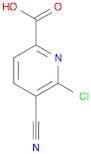
CAS 53234-56-3
:6-Chloro-5-cyano-2-pyridinecarboxylic acid
Description:
6-Chloro-5-cyano-2-pyridinecarboxylic acid is a heterocyclic organic compound characterized by its pyridine ring, which contains both a chloro and a cyano group, as well as a carboxylic acid functional group. The presence of the chloro substituent at the 6-position and the cyano group at the 5-position contributes to its unique chemical reactivity and potential applications in various fields, including pharmaceuticals and agrochemicals. This compound is typically a solid at room temperature and is soluble in polar solvents, which is common for carboxylic acids. Its acidic nature is attributed to the carboxylic acid group, allowing it to participate in acid-base reactions. The cyano group can also engage in nucleophilic reactions, making this compound versatile in synthetic chemistry. Additionally, the presence of the pyridine ring may impart specific biological activities, making it of interest in medicinal chemistry. Overall, 6-Chloro-5-cyano-2-pyridinecarboxylic acid is a valuable compound for research and development in various chemical applications.
Formula:C7H3ClN2O2
InChI:InChI=1S/C7H3ClN2O2/c8-6-4(3-9)1-2-5(10-6)7(11)12/h1-2H,(H,11,12)
InChI key:InChIKey=ROPFRDWKBGCDEZ-UHFFFAOYSA-N
SMILES:C(O)(=O)C=1N=C(Cl)C(C#N)=CC1
Synonyms:- 6-Chloro-5-cyanopyridine-2-carboxylic acid
- 6-Chloro-5-cyanopicolinic acid
- 2-Pyridinecarboxylic acid, 6-chloro-5-cyano-
- 6-Chloro-5-cyano-2-pyridinecarboxylic acid
Sort by
Purity (%)
0
100
|
0
|
50
|
90
|
95
|
100
Found 4 products.
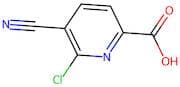
6-Chloro-5-cyanopicolinic acid
CAS:Formula:C7H3ClN2O2Purity:98%Color and Shape:SolidMolecular weight:182.56396-Chloro-5-cyanopicolinic acid
CAS:6-Chloro-5-cyanopicolinic acidPurity:98%Molecular weight:182.566g/mol6-chloro-5-cyanopyridine-2-carboxylic acid
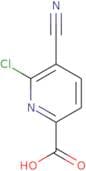
CAS:6-Chloro-5-cyanopyridine-2-carboxylic acid is an antitumor agent that inhibits tumor cell proliferation and induces cell death. It has been shown to be a selective inhibitor of the enzyme hepg2, which is involved in the conversion of cholesterol to bile acids. 6-Chloro-5-cyanopyridine-2-carboxylic acid has also been shown to inhibit the growth of tumor cells by binding to pyrimidine derivatives and acylating them. This reaction leads to the formation of reactive nitrogen species that cause DNA damage and lead to apoptotic cell death. The compound can be synthesized efficiently through an acylation reaction with benzoyl chloride.Formula:C7H3ClN2O2Purity:Min. 95%Molecular weight:182.6 g/mol