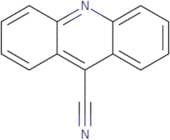
CAS 5326-19-2
:acridine-9-carbonitrile
Description:
Acridine-9-carbonitrile, with the CAS number 5326-19-2, is an organic compound characterized by its acridine backbone, which is a tricyclic structure composed of a fused ring system containing nitrogen. This compound features a cyano group (-C≡N) attached to the 9-position of the acridine ring, which significantly influences its chemical properties and reactivity. Acridine-9-carbonitrile is typically a solid at room temperature and may exhibit moderate solubility in organic solvents. It is known for its potential applications in various fields, including pharmaceuticals, where it may serve as a precursor or intermediate in the synthesis of biologically active compounds. The presence of the cyano group can enhance its reactivity, making it useful in nucleophilic substitution reactions. Additionally, acridine derivatives are often studied for their photophysical properties, which can be relevant in the development of dyes and fluorescent materials. Safety data should be consulted, as acridine derivatives can exhibit toxicity and environmental hazards.
Formula:C14H8N2
InChI:InChI=1/C14H8N2/c15-9-12-10-5-1-3-7-13(10)16-14-8-4-2-6-11(12)14/h1-8H
SMILES:c1ccc2c(c1)c(C#N)c1ccccc1n2
Sort by
Purity (%)
0
100
|
0
|
50
|
90
|
95
|
100
Found 2 products.
Acridine-9-carbonitrile
CAS:Acridine-9-carbonitrile is a fluorescent dye that is sensitive to peroxide. Acridine-9-carbonitrile has been used as a hydrogen peroxide probe in the determination of peroxidase activity, and it has also been used as an oxidizing agent in organic synthesis. It is also active against carbamazepine and fluorophore. Acridine-9-carbonitrile can be activated by irradiation with ultraviolet light or by nitrous oxide. This compound was first synthesized in 1891, and has been studied for its advances in techniques such as fluorescence microscopy and DNA sequencing.Formula:C14H8N2Purity:Min. 95%Molecular weight:204.23 g/mol