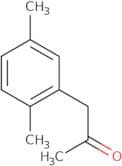
CAS 53291-89-7
:2,5-Dimethylphenylacetone
Description:
2,5-Dimethylphenylacetone, with the CAS number 53291-89-7, is an organic compound that belongs to the class of ketones. It features a phenyl group substituted with two methyl groups at the 2 and 5 positions, along with an acetone functional group. This compound is typically a colorless to pale yellow liquid with a characteristic odor. It is known for its use in organic synthesis and as a potential intermediate in the production of various pharmaceuticals and fragrances. The presence of the ketone functional group contributes to its reactivity, allowing it to participate in various chemical reactions, such as nucleophilic additions. Additionally, 2,5-Dimethylphenylacetone is relatively stable under standard conditions but should be handled with care due to potential health hazards associated with ketones. Its solubility in organic solvents makes it useful in various applications, although it is less soluble in water. Proper storage and handling protocols should be followed to ensure safety and maintain its integrity.
Formula:C11H14O
InChI:InChI=1/C11H14O/c1-8-4-5-9(2)11(6-8)7-10(3)12/h4-6H,7H2,1-3H3
SMILES:Cc1ccc(C)c(c1)CC(=O)C
Synonyms:- 1-(2,5-Dimethylphenyl)Propan-2-One
Sort by
Purity (%)
0
100
|
0
|
50
|
90
|
95
|
100
Found 3 products.
(2,5-Dimethylphenyl)acetone
CAS:2,5-Dimethylphenyl)acetone is an analogue of amphetamine that has been shown to have similar binding and uptake properties in the brain. This drug was synthesized for use in positron emission tomography (PET) studies on the distribution of amphetamine analogues in the human brain. It is also used as a radioligand for studies on cerebral uptake of amphetamines. 2,5-Dimethylphenyl)acetone itself has no significant central nervous system activity. However, it can be used to determine whether other drugs are able to cross the blood-brain barrier and enter the brain. Radiofluorination with iodine-123, which emits positrons during decay, yields a compound that binds to amines such as dopamine and norepinephrine receptors in the brain. The presence of these amines can then be detected using PET imaging techniques.END>Formula:C11H14OPurity:Min. 96 Area-%Color and Shape:Clear LiquidMolecular weight:162.23 g/mol