CAS 533-73-3
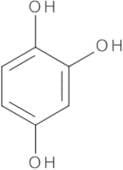
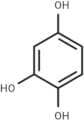
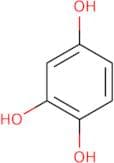
:1,2,4-Benzenetriol
Description:
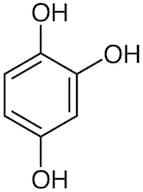
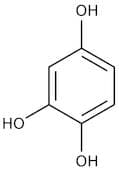
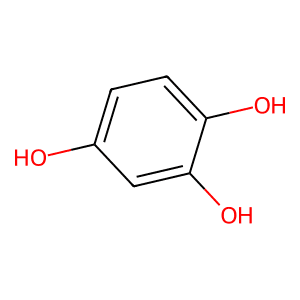
1,2,4-Benzenetriol, also known as 1,2,4-trihydroxybenzene, is an aromatic compound characterized by the presence of three hydroxyl (-OH) groups attached to a benzene ring at the 1, 2, and 4 positions. This compound appears as a white to light yellow solid and is soluble in water due to its multiple hydroxyl groups, which enhance its polarity. 1,2,4-Benzenetriol exhibits antioxidant properties and can participate in various chemical reactions, including oxidation and substitution reactions. It is often used in organic synthesis and as an intermediate in the production of dyes, pharmaceuticals, and other chemical compounds. The presence of multiple hydroxyl groups also allows it to form hydrogen bonds, influencing its reactivity and interactions with other substances. Additionally, it may have applications in biochemistry and materials science due to its potential as a reducing agent and its role in the stabilization of certain chemical structures. Safety precautions should be taken when handling this compound, as with many chemicals, to avoid potential health hazards.
Formula:C6H6O3
InChI:InChI=1S/C6H6O3/c7-4-1-2-5(8)6(9)3-4/h1-3,7-9H
InChI key:InChIKey=GGNQRNBDZQJCCN-UHFFFAOYSA-N
SMILES:OC1=C(O)C=CC(O)=C1
Synonyms:- 1,2,4-Benzenetriol
- 1,2,4-Benzentril
- 1,2,4-Trihydroxybenzol
- 1,2,5-Benzenetriol
- 1,3,4-Benzenetriol
- 1,3,4-Trihydroxybenzene
- 2,5-Dihydroxyphenol
- 2-Hydroxy-1,4-hydroquinone
- 2-Hydroxy-p-benzohydroquinone
- 2-Hydroxyhydroquinone
- 4-Hydroxycatechol
- Benceno-1,2,4-Triol
- Benzene-1,2,3-Triol
- Benzene-1,2,4-Triol
- Benzol-1,2,4-triol
- HHQ
- Hydroxyhydroquinone
- Nsc 2818
- See more synonyms
Sort by
Purity (%)
0
100
|
0
|
50
|
90
|
95
|
100
Found 13 products.
1,2,4-Trihydroxybenzene
CAS:Formula:C6H6O3Purity:>98.0%(GC)Color and Shape:White to Gray to Brown powder to crystalMolecular weight:126.111,2,4-Trihydroxybenzene, 97%
CAS:1,2,4-Trihydroxybenzene is an important raw material and intermediate used in organic Synthesis, pharmaceuticals, agrochemicals and dyestuff.It is used as a metabolite of benzene. This Thermo Scientific Chemicals brand product was originally part of the Alfa Aesar product portfolio. Some documentatiFormula:C6H6O3Purity:97%Color and Shape:White to grey or pale pink to pale brown to brown, PowderMolecular weight:126.11Phloroglucinol EP Impurity E (1,2,4-Trihydroxybenzene)
CAS:Formula:C6H6O3Color and Shape:White To Off-White SolidMolecular weight:126.111,2,4-Trihydroxybenzene
CAS:1,2,4-TrihydroxybenzeneFormula:C6H6O3Purity:95%Color and Shape: faint orange/brown powderMolecular weight:126.11g/molPhloroglucinol EP Impurity E
CAS:Controlled ProductFormula:C6H6O3Color and Shape:NeatMolecular weight:126.111,2,4-Benzenetriol
CAS:Controlled ProductApplications A metabolite of benzene.
References Aoyama, K., et al.: Toxicol. Appl. Pharmacol., 85, 92 (1986), Sutter, T., et al.: J. Biol. Chem., 269, 1309 (1994), Farris, G., et al.: Toxicology, 118, 137 (1997), Jason, J., et al.: J. Immunol. Methods, 207, 13 (1997), Lee, M., et al.: Immunology, 106, 496 (2002),Formula:C6H6O3Color and Shape:NeatMolecular weight:126.111,2,4-Trihydroxybenzene
CAS:1,2,4-Trihydroxybenzene (Benzene-1,2,4-triol) is a by-product of coffee bean roasting and is found in mouse, arabica coffee.1,2,4-Trihydroxybenzene is aFormula:C6H6O3Purity:99.69%Color and Shape:SolidMolecular weight:126.111,2,4-Benzenetriol technical grade
CAS:1,2,4-Benzenetriol (BNT) is a reactive molecule that has been shown to have hydrogen bonding interactions with copper chloride. It has been proposed as an inhibitor of methyltransferase, which is involved in the synthesis of methionine. Studies have shown that BNT can also inhibit iron homeostasis and transfer reactions. The x-ray diffraction data for this compound shows that it forms a complex with the hydroxyl group. This complex is stabilized by hydrogen bonding interactions with the hydroxylic proton of the 1,2,4-benzenetriol molecule. BNT has been shown to be toxic to HL-60 cells and K562 cells at concentrations greater than 5 mM. It has also been found to be effective against chlorogenic acids and other compounds in energy metabolism studies at concentrations between 0.5 and 2 mM.Formula:C6H6O3Purity:Min. 95%Color and Shape:PowderMolecular weight:126.11 g/mol1,2,4-Trihydroxybenzene
CAS:Formula:C6H6O3Purity:95%Color and Shape:Pale yellow – Greyish reddish yellow powderMolecular weight:126.111