CAS 5333-45-9
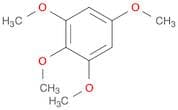
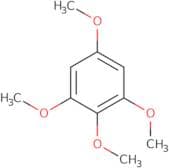
:1,2,3,5-Tetramethoxybenzene
Description:
1,2,3,5-Tetramethoxybenzene is an organic compound characterized by a benzene ring substituted with four methoxy groups (-OCH3) at the 1, 2, 3, and 5 positions. This compound is a member of the methoxy-substituted aromatic hydrocarbons and is known for its potential applications in organic synthesis and as a precursor in the development of various chemical compounds. It typically appears as a colorless to pale yellow liquid or solid, depending on the temperature and purity. The presence of multiple methoxy groups enhances its solubility in organic solvents and can influence its reactivity, making it a useful intermediate in the synthesis of more complex molecules. Additionally, the compound may exhibit interesting electronic properties due to the electron-donating nature of the methoxy groups, which can affect its behavior in chemical reactions and interactions with other substances. Safety data should be consulted for handling and storage, as with all chemical substances.
Formula:C10H14O4
InChI:InChI=1/C10H14O4/c1-11-7-5-8(12-2)10(14-4)9(6-7)13-3/h5-6H,1-4H3
SMILES:COc1cc(c(c(c1)OC)OC)OC
Sort by
Purity (%)
0
100
|
0
|
50
|
90
|
95
|
100
Found 3 products.
1,2,3,5-Tetramethoxybenzene
CAS:Formula:C10H14O4Purity:95%Color and Shape:SolidMolecular weight:198.21581,2,3,5-Tetramethoxybenzene
CAS:Controlled Product1,2,3,5-Tetramethoxybenzene is a tannin that belongs to the class of arenes. It can be synthesized by Friedel-Crafts acylation of benzene with an acyl chloride in the presence of aluminum chloride. This reaction produces 1,2,3,5-tetramethoxybenzene and triketone as byproducts. The synthetic pathway for this compound is based on techniques such as irradiation and thermally induced rearrangement. The oxidized form has a redox potential of -0.6 V vs NHE (normal hydrogen electrode). Methoxy groups on the aromatic ring increase the electron affinity and lower the redox potential.Formula:C10H14O4Purity:Min. 95%Color and Shape:White PowderMolecular weight:198.22 g/mol