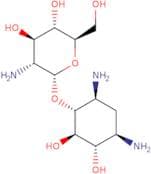
CAS 534-47-4
:Paromamine
Description:
Paromamine, with the CAS number 534-47-4, is a chemical compound that belongs to the class of aminoglycoside antibiotics. It is primarily characterized by its amino sugar structure, which is essential for its biological activity. Paromamine exhibits antibacterial properties, particularly against a range of Gram-negative bacteria, making it valuable in the field of microbiology and pharmacology. The compound functions by inhibiting protein synthesis in bacteria, thereby exerting its antimicrobial effects. Paromamine is often studied for its potential applications in treating infections, especially in cases where resistance to other antibiotics is a concern. Additionally, its chemical structure includes multiple hydroxyl groups, contributing to its solubility in water and its interaction with biological systems. As with many aminoglycosides, the use of paromamine may be associated with certain side effects, particularly nephrotoxicity and ototoxicity, which necessitates careful monitoring during therapeutic use. Overall, paromamine represents an important compound in antibiotic research and development.
Formula:C12H25N3O7
InChI:InChI=1S/C12H25N3O7/c13-3-1-4(14)11(10(20)7(3)17)22-12-6(15)9(19)8(18)5(2-16)21-12/h3-12,16-20H,1-2,13-15H2/t3-,4+,5-,6-,7+,8-,9-,10-,11-,12-/m1/s1
InChI key:InChIKey=JGSMDVGTXBPWIM-HKEUSBCWSA-N
SMILES:O([C@H]1[C@H](O)[C@@H](O)[C@H](N)C[C@@H]1N)[C@H]2O[C@H](CO)[C@@H](O)[C@H](O)[C@H]2N
Synonyms:- Neomycin D
- 4-O-α-D-Glucosaminyl-2-deoxystreptamine
- 4-O-(2-Amino-2-deoxy-α-D-glucopyranosyl)-2-deoxy-D-streptamine
- Paromamine
- D-Streptamine, 4-O-(2-amino-2-deoxy-α-D-glucopyranosyl)-2-deoxy-
Sort by
Purity (%)
0
100
|
0
|
50
|
90
|
95
|
100
Found 2 products.
Paromamine 3HCl
CAS:Paromamine is a chemical compound that inhibits protein synthesis by enzymatic inactivation. It has been shown to have a broad spectrum of antibacterial activity against Gram-positive and Gram-negative bacteria. Paromamine also has the ability to inhibit bacterial growth at high salt concentrations, making it an attractive candidate for development as an oral antibiotic drug. Paromamine is synthesized from natural products, such as salicylaldehyde or phenylhydrazine, which are readily available and inexpensive. The reaction mechanism for the formation of paromamine starts with dehydration of the hydroxyl group on the hydrazine to form a carbonyl group. This carbonyl group reacts with sephadex g-100 to form a cyanohydrin. The cyanohydrin reacts with ammonia to form an amide bond between the two nitrogen atoms in the molecule, which forms paromamine.Formula:C12H25N3O7·3HClPurity:Min. 95%Molecular weight:323.34 g/mol