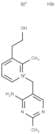
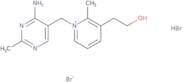
![Pyridinium, 1-[(4-amino-2-methyl-5-pyrimidinyl)methyl]-3-(2-hydroxyethyl)-2-methyl-, bromide, hydr…](/_next/image/?url=https%3A%2Fstatic.cymitquimica.com%2Fcas-image%2Fthumb-webp%2F392747-neopyrithiamine-hydrobromide.webp&w=3840&q=75)
CAS 534-64-5
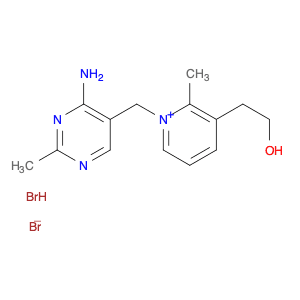
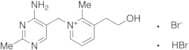
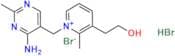
:Pyridinium, 1-[(4-amino-2-methyl-5-pyrimidinyl)methyl]-3-(2-hydroxyethyl)-2-methyl-, bromide, hydrobromide (1:1:1)
Description:
Pyridinium, 1-[(4-amino-2-methyl-5-pyrimidinyl)methyl]-3-(2-hydroxyethyl)-2-methyl-, bromide, hydrobromide (1:1:1), commonly referred to by its CAS number 534-64-5, is a quaternary ammonium compound characterized by its pyridinium structure, which includes a pyrimidine moiety. This compound typically exhibits properties such as solubility in water and polar organic solvents due to its ionic nature, attributed to the presence of bromide ions. It is often utilized in biochemical and pharmaceutical applications, particularly as a reagent or in drug formulation due to its ability to interact with biological systems. The presence of amino and hydroxyl functional groups suggests potential for hydrogen bonding, influencing its reactivity and interaction with other molecules. Additionally, the compound's structure may confer specific biological activities, making it of interest in medicinal chemistry. Safety data should be consulted for handling and usage, as quaternary ammonium compounds can exhibit varying degrees of toxicity and environmental impact.
Formula:C14H20Br2N4O
InChI:InChI=1/C14H19N4O.2BrH/c1-10-12(5-7-19)4-3-6-18(10)9-13-8-16-11(2)17-14(13)15;;/h3-4,6,8,19H,5,7,9H2,1-2H3,(H2,15,16,17);2*1H/q+1;;/p-1
InChI key:InChIKey=DMVBWVASDWGFNH-UHFFFAOYSA-M
SMILES:C([N+]=1C(C)=C(CCO)C=CC1)C=2C(N)=NC(C)=NC2.[Br-].Br
Synonyms:- 1-(4-Ammonio-2-Methylpyrimidin-5-Yl)-3-(2-Hydroxyethyl)-2-Methylpyridinium Dibromide
- 1-[(4-Amino-2-Methylpyrimidin-5-Yl)Methyl]-3-(2-Hydroxyethyl)-2-Methylpyridinium Bromide Hydrobromide (1:1:1)
- 2-Picolinium, 1-[(4-amino-2-methyl-5-pyrimidinyl)methyl]-3-(2-hydroxyethyl)-, bromide, monohydrobromide
- Neopyrithiamine
- Pyridinium, 1-[(4-amino-2-methyl-5-pyrimidinyl)methyl]-3-(2-hydroxyethyl)-2-methyl-, bromide, hydrobromide (1:1:1)
- Pyridinium, 1-[(4-amino-2-methyl-5-pyrimidinyl)methyl]-3-(2-hydroxyethyl)-2-methyl-, bromide, monohydrobromide
- Pyrithiamin
- Pyrithiamin hydrobromide
- Pyrithiamine
- Pyrithiamine bromide hydrobromide
- 1-([4-amino-2-methyl]-5-pyrimidylmethyl)-2-methyl-3-(β-hydroxyethyl)pyridinium bromide
- Neopyrithiaminehydrobromideappox.
- NEOPYRITHIAMINE HYDROBROMIDE
- PyrithiaMine hydrobroMide ~95%, crystalline
- 2-[1-[(4-amino-2-methyl-pyrimidin-5-yl)methyl]-2-methyl-pyridin-1-ium-3-yl]ethanol bromide hydrobromide
- PYRITHIAMINE HYDROBROMIDE
- 1-[(4-AMino-2-Methyl-5-pyriMidinyl)Methyl]-3-(2-hydroxyethyl)-2-MethylpyridiniuM BroMide HydrobroMide
- Pyrithiamine hydrobromide,1-([4-Amino-2-methyl]-5-pyrimidylmethyl)-2-methyl-3-(β-hydroxyethyl)pyridinium bromide, Neopyrithiamine
- 1-[(4-AMINO-2-METHYL)-5-PYRIMIDYLMETHYL]-2-METHYL-3-[BETA-HYDROXYETHYL]-PYRIDINIUM BROMIDE HYDROBROMIDE
- 2-[1-[(4-amino-2-methylpyrimidin-5-yl)methyl]-2-methylpyridin-1-ium-3-yl]ethanol bromide hydrobromide
- 2-[1-[(4-azanyl-2-methyl-pyrimidin-5-yl)methyl]-2-methyl-pyridin-1-ium-3-yl]ethanol bromide hydrobromide
- See more synonyms
Sort by
Purity (%)
0
100
|
0
|
50
|
90
|
95
|
100
Found 7 products.
Pyrithiamine
CAS:Controlled ProductApplications Thiamine (T344185) antagonist. Thiamine (T344185) analog.
References Cooper, J., et al.: J. Neurochem., 19, 1809 (1972), Patrini, C., et al.: Brain Res., 628, 179 (1993), Nauti, A., et al.: Metab. Brain Dis., 12, 145 (1997),Formula:C14H19N4O·HBr·BrColor and Shape:Light Yellow To Light BeigeMolecular weight:420.15Pyrithiamine hydrobromide
CAS:Pyrithiamine hydrobromide, an inhibitor of thiamine metabolism substrate for thiamine pyrophosphate kinase, causes neurologic symptoms wernickke - korsakoff .Formula:C14H20Br2N4OColor and Shape:SolidMolecular weight:420.14Pyrithiamine
CAS:Pyrithiamine is an antimicrobial agent that inhibits the growth of bacteria by disrupting the disulfide bond between two cysteine residues. It has been shown to inhibit the formation of bacterial spores, which are resistant to many antibiotics. Pyrithiamine also has antioxidant properties and can reduce oxidative stress in neurons, leading to neuronal death. This drug also has a strong effect on energy metabolism and may be used as a treatment for mitochondrial diseases.
Formula:C14H20Br2N4OPurity:Min. 95%Molecular weight:420.14 g/mol