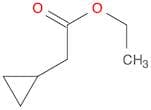
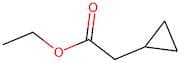
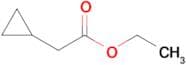
CAS 53432-87-4
:Ethyl cyclopropaneacetate
Description:
Ethyl cyclopropaneacetate, with the CAS number 53432-87-4, is an organic compound characterized by its unique structure, which includes a cyclopropane ring and an ester functional group. This compound typically appears as a colorless to pale yellow liquid with a pleasant, fruity odor, making it potentially useful in flavor and fragrance applications. Ethyl cyclopropaneacetate is known for its moderate volatility and relatively low solubility in water, while being more soluble in organic solvents. Its chemical properties include reactivity typical of esters, such as hydrolysis in the presence of acids or bases, and it may undergo various reactions including transesterification and nucleophilic substitutions. The compound's stability under standard conditions allows for its use in synthetic organic chemistry, where it can serve as an intermediate in the synthesis of more complex molecules. Safety data indicates that, like many organic compounds, it should be handled with care, as it may pose risks such as irritation upon contact with skin or eyes.
Formula:C7H12O2
Sort by
Purity (%)
0
100
|
0
|
50
|
90
|
95
|
100
Found 4 products.
Ethyl cyclopropaneacetate
CAS:Formula:C7H12O2Purity:96%Color and Shape:LiquidMolecular weight:128.1690Ref: IN-DA00DLVA
100gTo inquire250gTo inquire500gTo inquire100mg28.00€250mg31.00€1g53.00€5g87.00€10g155.00€25g239.00€Ethyl 2-cyclopropylacetate
CAS:Formula:C7H12O2Purity:95%Color and Shape:LiquidMolecular weight:128.171ethyl cyclopropaneacetate
CAS:Ethyl cyclopropaneacetate is an organic compound that belongs to the class of aminophenyl ethyl esters. It has been shown to inhibit neutrophil migration and angiotensin II-induced vasoconstriction in cerebral arteries, suggesting that it may have a role in the treatment of chronic bronchitis. Ethyl cyclopropaneacetate has also been shown to have antimycotic activity against Candida albicans and Aspergillus niger, as well as cancer-fighting effects. This compound is synthesized by reacting triethyl orthoformate with adenosine under mild conditions. The reaction system is high yielding and can be used for the synthesis of other drugs.Formula:C7H12O2Purity:Min. 95%Molecular weight:128.17 g/mol