CAS 53446-90-5
:4-trifluoroacetyl-P-phenylenediamine
Description:
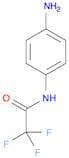
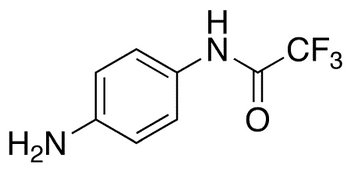
4-Trifluoroacetyl-P-phenylenediamine, with the CAS number 53446-90-5, is an organic compound characterized by the presence of a trifluoroacetyl group attached to a p-phenylenediamine structure. This compound typically exhibits a solid state at room temperature and is known for its potential applications in dye chemistry and as an intermediate in organic synthesis. The trifluoroacetyl group contributes to its unique reactivity and stability, influencing its solubility in various organic solvents. Additionally, the presence of the amino groups in the p-phenylenediamine framework allows for further functionalization, making it a versatile building block in the synthesis of more complex molecules. The compound may also exhibit specific optical properties, which can be utilized in various analytical applications. As with many fluorinated compounds, it is essential to handle 4-trifluoroacetyl-P-phenylenediamine with care due to potential toxicity and environmental concerns associated with fluorinated substances. Proper safety protocols should be followed when working with this chemical.
Formula:C8H7F3N2O
InChI:InChI=1/C8H7F3N2O/c9-8(10,11)7(14)13-6-3-1-5(12)2-4-6/h1-4H,12H2,(H,13,14)
SMILES:c1cc(ccc1N)NC(=O)C(F)(F)F
Synonyms:- 4-Trifluoroacetamidoaniline
- N-(4-aminophenyl)-2,2,2-trifluoroacetamide
Sort by
Purity (%)
0
100
|
0
|
50
|
90
|
95
|
100
Found 5 products.
N-(4-Aminophenyl)-2,2,2-trifluoroacetamide
CAS:Formula:C8H7F3N2OColor and Shape:SolidMolecular weight:204.1492N-(4-Aminophenyl)trifluoroacetamide
CAS:N-(4-Aminophenyl)trifluoroacetamidePurity:≥95%Molecular weight:204.15g/mol4-Trifluoroacetamidoaniline
CAS:Formula:C8H7F3N2OPurity:98.0%Color and Shape:SolidMolecular weight:204.1524-Trifluoroacetamidoaniline
CAS:Controlled ProductApplications TFAN reacts with reducing oligosaccharides in the presence of sodium cyanoborohydride to give aminoalditol derivatives, useful for linking to proteins or solid matrices. Treated this way, reducing oligosaccharides were easily separated by HPLC.
References Wong, H., et al.: J. Med. Chem., 17, 785 (1974), Kallin, E., et al.: Glycoconjugate Journal, 3, 311 (1986)Formula:C8H7F3N2OColor and Shape:NeatMolecular weight:204.15