CAS 53526-66-2
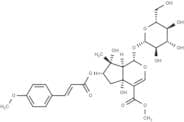
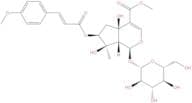
:methyl (1S,4aR,6S,7R,7aS)-1-(beta-D-glucopyranosyloxy)-4a,7-dihydroxy-6-{[(2E)-3-(4-methoxyphenyl)prop-2-enoyl]oxy}-7-methyl-1,4a,5,6,7,7a-hexahydrocyclopenta[c]pyran-4-carboxylate
Description:
The chemical substance with the name "methyl (1S,4aR,6S,7R,7aS)-1-(beta-D-glucopyranosyloxy)-4a,7-dihydroxy-6-{[(2E)-3-(4-methoxyphenyl)prop-2-enoyl]oxy}-7-methyl-1,4a,5,6,7,7a-hexahydrocyclopenta[c]pyran-4-carboxylate" and CAS number 53526-66-2 is a complex organic compound characterized by its intricate molecular structure, which includes multiple stereocenters and functional groups. It features a glucopyranosyl moiety, indicating it is a glycoside, and contains hydroxyl groups that contribute to its potential solubility in polar solvents. The presence of a methoxyphenyl group suggests possible aromatic interactions, which may influence its biological activity. Additionally, the hexahydrocyclopenta structure indicates a fused ring system, which can affect the compound's conformational flexibility and stability. This compound may exhibit various pharmacological properties, making it of interest in medicinal chemistry and natural product research. Its specific interactions and applications would depend on further studies, including its reactivity, bioavailability, and potential therapeutic effects.
Formula:C27H34O14
InChI:InChI=1/C27H34O14/c1-26(34)17(40-18(29)9-6-13-4-7-14(36-2)8-5-13)10-27(35)15(23(33)37-3)12-38-25(22(26)27)41-24-21(32)20(31)19(30)16(11-28)39-24/h4-9,12,16-17,19-22,24-25,28,30-32,34-35H,10-11H2,1-3H3/b9-6+/t16-,17+,19-,20+,21-,22-,24+,25+,26+,27+/m1/s1
Sort by
Purity (%)
0
100
|
0
|
50
|
90
|
95
|
100
Found 3 products.
Durantoside II
CAS:Durantoside II is a natural product of Duranta, Verbenaceae.Formula:C27H34O14Purity:98%Color and Shape:SolidMolecular weight:582.555Durantoside II
CAS:Durantoside II is a natural glycoside compound, which is derived from plant sources, specifically from species within the plant genus Duranta. Its mode of action involves modulation of biochemical pathways, potentially influencing enzymes or receptors involved in various biological processes. As a saponin-like compound, it may interact with cell membranes and proteins, altering cellular signaling and metabolic pathways.
Formula:C27H34O14Purity:Min. 95%Molecular weight:582.5 g/mol