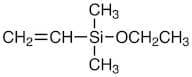
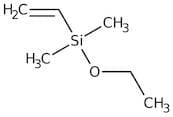
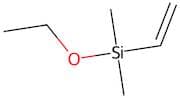
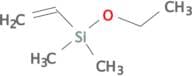
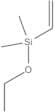
CAS 5356-83-2
:Vinyldimethylethoxysilane
- Dimethyl(ethenyl)silyloxyethane
- Dimethyl(vinyl)silyl ethyl ether
- Dimethyl-Vinyl-Ethoxysilane
- Dimethylethoxyvinylsilane
- Dimethylvinylethoxysilane
- Ethenyl(ethoxy)dimethylsilane
- Ethenylethoxydimethyl-Silan
- Ethenylethoxydimethylsilane
- Ethoxydimethylvinylsilane
- Ethoxyvinyldimethylsilane
- NSC 8963
- Silane, ethenylethoxydimethyl-
- Silane, ethoxydimethylvinyl-
- V 0046
- Vinyl dimethyl ethoxy silane
- Vinyldimethylethoxysilane
- See more synonyms
Dimethylethoxyvinylsilane
CAS:Formula:C6H14OSiPurity:>98.0%(GC)Color and Shape:Colorless to Almost colorless clear liquidMolecular weight:130.26Dimethylethoxyvinylsilane, 97%
CAS:This Thermo Scientific Chemicals brand product was originally part of the Alfa Aesar product portfolio. Some documentation and label information may refer to the legacy brand. The original Alfa Aesar product / item code or SKU reference has not changed as a part of the brand transition to Thermo SciFormula:C6H14OSiPurity:97%Color and Shape:Clear colorless, LiquidMolecular weight:130.26VINYLDIMETHYLETHOXYSILANE
CAS:Formula:C6H14OSiPurity:98%Color and Shape:SolidMolecular weight:130.2603Vinyldimethylethoxysilane
CAS:S21725 - Vinyldimethylethoxysilane
Formula:C6H14OSiPurity:95%Color and Shape:ClearMolecular weight:130.262VINYLDIMETHYLETHOXYSILANE
CAS:Olefin Functional Monoalkoxy Silane
Silane coupling agents have the ability to form a durable bond between organic and inorganic materials to generate desired heterogeneous environments or to incorporate the bulk properties of different phases into a uniform composite structure. The general formula has two classes of functionality. The hydrolyzable group forms stable condensation products with siliceous surfaces and other oxides such as those of aluminum, zirconium, tin, titanium, and nickel. The organofunctional group alters the wetting or adhesion characteristics of the substrate, utilizes the substrate to catalyze chemical transformations at the heterogeneous interface, orders the interfacial region, or modifies its partition characteristics, and significantly effects the covalent bond between organic and inorganic materials.
Alkenylsilane Cross-Coupling Agent
The cross-coupling reaction is a highly useful methodology for the formation of carbon-carbon bonds. It involves two reagents, with one typically being a suitable organometallic reagent - the nucleophile - and the other a suitable organic substrate, normally an unsaturated halide, tosylate or similar - the electrophile.
Vinyldimethylethoxysilane; Dimethylvinylethoxysilane; Ethenyldimethylethoxysilane; Ethoxydimethylvinylsilane; Dimethylethoxyvinylsilane; (Ethoxydimethyl)silylethylene
Used in microparticle surface modificationDipole moment: 1.23 debyeVinylates aryl halidesExtensive review of silicon based cross-coupling agents: Denmark, S. E. et al. "Organic Reactions, Volume 75" Denmark, S. E. ed., John Wiley and Sons, 233, 2011Formula:C6H14OSiPurity:97%Color and Shape:LiquidMolecular weight:130.26