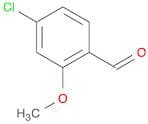
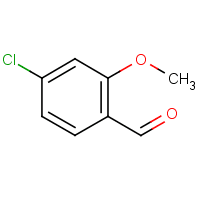
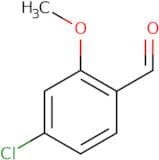
CAS 53581-86-5
:4-Chloro-2-methoxybenzaldehyde
Description:
4-Chloro-2-methoxybenzaldehyde, with the CAS number 53581-86-5, is an organic compound that belongs to the class of aromatic aldehydes. It features a benzene ring substituted with both a chloro group and a methoxy group, along with an aldehyde functional group. This compound typically appears as a pale yellow to light brown liquid or solid, depending on its purity and form. It is known for its characteristic aromatic odor. The presence of the chloro and methoxy substituents influences its reactivity and solubility, making it soluble in organic solvents like ethanol and ether, but less soluble in water. 4-Chloro-2-methoxybenzaldehyde is utilized in various chemical syntheses, particularly in the production of pharmaceuticals and agrochemicals, due to its ability to undergo electrophilic aromatic substitution and other reactions. Safety precautions should be observed when handling this compound, as it may pose health risks if inhaled or ingested, and appropriate protective equipment should be used.
Formula:C8H7ClO2
InChI:InChI=1/C8H7ClO2/c1-11-8-4-7(9)3-2-6(8)5-10/h2-5H,1H3
SMILES:COc1cc(ccc1C=O)Cl
Synonyms:- Benzaldehyde, 4-Chloro-2-Methoxy-
Sort by
Purity (%)
0
100
|
0
|
50
|
90
|
95
|
100
Found 4 products.
4-Chloro-2-methoxybenzaldehyde
CAS:Formula:C8H7ClO2Purity:98%Color and Shape:SolidMolecular weight:170.59304-Chloro-2-methoxybenzaldehyde
CAS:4-Chloro-2-methoxybenzaldehydePurity:98%Molecular weight:170.59g/mol4-Chloro-2-methoxybenzaldehyde
CAS:Formula:C8H7ClO2Purity:95%Color and Shape:SolidMolecular weight:170.594-Chloro-2-methoxybenzaldehyde
CAS:4-Chloro-2-methoxybenzaldehyde is a bipolar compound that is optically active. It has been shown to have antipsychotic properties in both animal and human studies. 4-Chloro-2-methoxybenzaldehyde inhibits the production of dopamine, which may lead to its antipsychotic activity. The molecular mechanism of action for this compound is not known, but it has been hypothesized that it may inhibit the enzyme tyrosine hydroxylase, which catalyzes the conversion of tyrosine to l-dopa. This would lead to a decrease in dopamine levels and an increase in serotonin levels.Formula:C8H7ClO2Purity:Min. 95%Molecular weight:170.59 g/mol