CAS 536-28-7
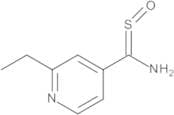
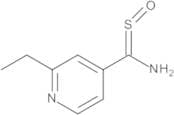
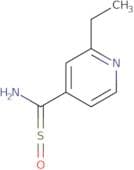
:Ethionamide sulfoxide
Description:
Ethionamide sulfoxide, with the CAS number 536-28-7, is a chemical compound that serves as a metabolite of ethionamide, an antibiotic primarily used in the treatment of tuberculosis. This compound is characterized by its sulfoxide functional group, which typically imparts unique chemical properties, including increased polarity and potential for hydrogen bonding. Ethionamide sulfoxide is generally a white to off-white solid, and it is soluble in polar solvents such as water and alcohols, which enhances its bioavailability. The compound exhibits antibacterial activity, contributing to its therapeutic effects. Additionally, it may have implications in pharmacokinetics and drug interactions due to its metabolic pathway. As with many sulfoxides, it may also exhibit stability under various conditions, although it can be sensitive to strong oxidizing agents. Overall, ethionamide sulfoxide plays a significant role in the pharmacological landscape, particularly in the context of treating resistant strains of tuberculosis.
Formula:C8H10N2OS
InChI:InChI=1S/C8H10N2OS/c1-2-7-5-6(3-4-10-7)8(9)12-11/h3-5H,2,9H2,1H3
InChI key:InChIKey=QDQQNGZRIJPDGA-UHFFFAOYSA-N
SMILES:C(=S=O)(N)C=1C=C(CC)N=CC1
Synonyms:- 4-Pyridinecarbothioamide, 2-ethyl-, S-oxide
- 4-Pyridinemethanamine, 2-ethyl-α-sulfinyl-
- Ethionamide sulfoxide
- 2-Ethyl-α-sulfinyl-4-pyridinemethanamine
- Isonicotinamide, 2-ethylthio-, S-oxide
Sort by
Purity (%)
0
100
|
0
|
50
|
90
|
95
|
100
Found 6 products.
Ethionamide Sulfoxide
CAS:Controlled ProductApplications The major metabolite of Ethionamide.
References Rivera-Marrero, C., et al.: Microb. Pathog., 25, 307 (1998), Baulard, A., et al.: J. Biol. Chem., 275, 28326 (2000), Cole, S., et al.: Nature, 409, 1007 (2001), Liang, X., et al.: Bacteriology, 183, 843 (2001),Formula:C8H10N2OSColor and Shape:NeatMolecular weight:182.24Ethionamide sulfoxide
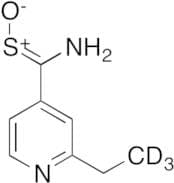
CAS:Ethionamide is a drug that is used for the treatment of tuberculosis. It binds to the enzyme preparations in the bacterial cell wall by competitive inhibition, which prevents formation of an antibiotic-inhibitor complex with the enzyme cell wall synthesis that is required for cell wall biosynthesis, inhibiting protein synthesis and cell division. The sulfoxide form of ethionamide is converted to the sulfone form when it enters the body. This conversion takes place primarily in the liver with assistance from alcohol dehydrogenase, cytochrome P450, and glutathione reductase. The sulfone form has higher potency than its precursor (sulfoxide) because it has lower protein binding affinity and more rapid elimination from plasma.Formula:C8H10N2OSPurity:Min. 95 Area-%Color and Shape:PowderMolecular weight:182.24 g/molEthionamide Sulfoxide-D3
CAS:Controlled ProductFormula:C8D3H7N2OSColor and Shape:NeatMolecular weight:185.26