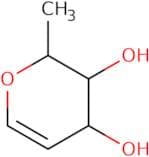
CAS 53657-42-4
:2,6-anhydro-1,5-dideoxyhex-5-enitol
Description:
2,6-Anhydro-1,5-dideoxyhex-5-enitol, with the CAS number 53657-42-4, is a chemical compound that belongs to the class of sugar derivatives. It is characterized by its unique structure, which includes an anhydro sugar moiety and a double bond, contributing to its reactivity and potential applications in organic synthesis. This compound is typically a colorless to pale yellow liquid or solid, depending on its purity and form. It is soluble in polar solvents like water and alcohols, which is common for many sugar derivatives. The presence of hydroxyl groups in its structure allows for hydrogen bonding, influencing its physical properties and reactivity. Additionally, 2,6-anhydro-1,5-dideoxyhex-5-enitol may exhibit biological activity, making it of interest in pharmaceutical and biochemical research. Its stability and reactivity can vary based on environmental conditions, such as pH and temperature, which are important considerations in its handling and application.
Formula:C6H10O3
InChI:InChI=1/C6H10O3/c1-4-6(8)5(7)2-3-9-4/h2-8H,1H3
SMILES:CC1C(C(C=CO1)O)O
Synonyms:- Hex-5-Enitol, 2,6-Anhydro-1,5-Dideoxy-
Sort by
Purity (%)
0
100
|
0
|
50
|
90
|
95
|
100
Found 1 products.
L-Rhamnal
CAS:L-Rhamnal is a sodium sulfide that is used in the synthesis of stereoselective compounds. It has been shown to have anti-leukemic properties and may be useful for the treatment of lymphocytic leukemia. L-Rhamnal has been shown to inhibit tumor growth and metastasis in animal models of cancer, as well as being cytotoxic to human leukemic cells. L-Rhamnal inhibits the proliferation of these cells by blocking DNA synthesis and preventing cell division. The hydroxymethyl group on L-rhamnal interacts with chloride ions to form a salt that can be degraded into hydrogen sulfide gas, which is known to be toxic to some organisms. The chloride ion also reacts with triterpene alcohols, glycosidic bonds, potassium phosphate, or borohydride reduction agents like sodium borohydride or lithium aluminum hydride. These reactions are used in carbohydrate chemistry and aldehydeFormula:C6H10O3Purity:Min. 95%Molecular weight:130.14 g/mol