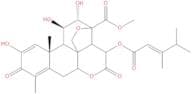
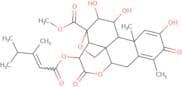
![methyl 15-[(3,4-dimethylpent-2-enoyl)oxy]-2,11,12-trihydroxy-3,16-dioxo-13,20-epoxypicrasa-1,4-die…](/_next/image/?url=https%3A%2Fstatic.cymitquimica.com%2Fcas-image%2Fthumb-webp%2F320386-methyl-15-34-dimethylpent-2-enoyl-oxy-21112-trihydroxy-316-dioxo-1320-epoxypicrasa-14-dien-21-oate.webp&w=3840&q=75)
CAS 53662-98-9
:methyl 15-[(3,4-dimethylpent-2-enoyl)oxy]-2,11,12-trihydroxy-3,16-dioxo-13,20-epoxypicrasa-1,4-dien-21-oate
Description:
Methyl 15-[(3,4-dimethylpent-2-enoyl)oxy]-2,11,12-trihydroxy-3,16-dioxo-13,20-epoxypicrasa-1,4-dien-21-oate, with CAS number 53662-98-9, is a complex organic compound characterized by its intricate molecular structure, which includes multiple functional groups such as hydroxyl (-OH), ester, and epoxide groups. This compound is derived from the natural product family of picrasane alkaloids, which are known for their diverse biological activities. The presence of multiple hydroxyl groups suggests potential for hydrogen bonding, influencing its solubility and reactivity. The dioxo and epoxide functionalities contribute to its chemical reactivity, making it a candidate for various synthetic transformations. Additionally, the compound's structural features may impart specific pharmacological properties, which could be of interest in medicinal chemistry. Its synthesis and applications may be explored in the context of drug development or as a biochemical probe, although specific biological activities would require further investigation. Overall, this compound exemplifies the complexity and diversity found in natural product chemistry.
Formula:C28H34O11
InChI:InChI=1/C28H34O11/c1-11(2)12(3)7-17(30)39-20-22-27-10-37-28(22,25(35)36-6)23(33)19(32)21(27)26(5)9-15(29)18(31)13(4)14(26)8-16(27)38-24(20)34/h7,9,11,16,19-23,29,32-33H,8,10H2,1-6H3
SMILES:CC(C)C(=CC(=O)OC1C2C34COC2(C(C(C4C2(C)C=C(C(=O)C(=C2CC3OC1=O)C)O)O)O)C(=O)OC)C
Sort by
Purity (%)
0
100
|
0
|
50
|
90
|
95
|
100
Found 3 products.
Dehydrobruceantin
CAS:Dehydrobruceantin is a quassinoid compound, which is derived from the Brucea antidysenterica plant. It acts as an antineoplastic agent through the inhibition of protein synthesis, affecting the proliferation of malignant cells. The compound interferes with the elongation phase of translation in protein synthesis, primarily by targeting and inhibiting the eukaryotic elongation factor 2 (eEF2). This mode of action disrupts the growth and survival of cancer cells, making it a subject of interest in oncology research.
Formula:C28H34O11Purity:Min. 95%Molecular weight:546.6 g/mol