CAS 53669-33-3
:4-Acetoxy-3,5-dimethoxybenzaldehyde
Description:
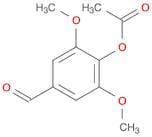
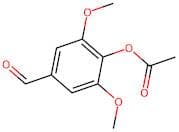
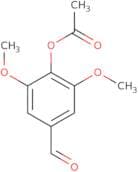
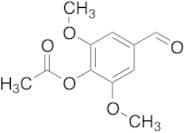
4-Acetoxy-3,5-dimethoxybenzaldehyde is an organic compound characterized by its aromatic structure, which includes a benzaldehyde functional group and two methoxy groups along with an acetoxy substituent. This compound typically appears as a pale yellow to light brown solid and is soluble in organic solvents such as ethanol and dichloromethane, but has limited solubility in water due to its hydrophobic nature. The presence of the acetoxy group contributes to its reactivity, making it a potential candidate for various chemical reactions, including acylation and condensation reactions. The methoxy groups enhance the electron-donating properties of the aromatic ring, influencing its reactivity and stability. This compound may be utilized in organic synthesis, particularly in the development of pharmaceuticals or as an intermediate in the synthesis of more complex molecules. Safety data indicates that, like many organic compounds, it should be handled with care, using appropriate personal protective equipment to avoid inhalation or skin contact.
Formula:C11H12O5
InChI:InChI=1S/C11H12O5/c1-7(13)16-11-9(14-2)4-8(6-12)5-10(11)15-3/h4-6H,1-3H3
InChI key:InChIKey=CSWKYHGBYCNZAS-UHFFFAOYSA-N
SMILES:O(C(C)=O)C1=C(OC)C=C(C=O)C=C1OC
Synonyms:- 4-(Acetyloxy)-3,5-dimethoxybenzaldehyde
- 4-Formyl-2,6-Dimethoxyphenyl Acetate
- 4-Formyl-2,6-dimethoxyphenol acetate
- Acetic acid 4-formyl-2,6-dimethoxyphenyl ester
- Benzaldehyde, 4-(acetyloxy)-3,5-dimethoxy-
- O-Acetylsyringaldehyde
- Syringaldehyde acetate
- 4-Acetoxy-3,5-dimethoxybenzaldehyde
Sort by
Purity (%)
0
100
|
0
|
50
|
90
|
95
|
100
Found 5 products.
4-Acetoxy-3,5-dimethoxybenzaldehyde
CAS:Formula:C11H12O5Purity:95%Color and Shape:SolidMolecular weight:224.21004-Formyl-2,6-dimethoxyphenyl acetate
CAS:4-Formyl-2,6-dimethoxyphenyl acetatePurity:95%Molecular weight:224.21g/mol4-Acetyl syringaldehyde
CAS:4-Acetyl syringaldehyde is a gaseous compound that has been shown to have antitumor properties. It is synthesized from 5-iodovanillin, which can be found in Australian marine sponge and organic acids such as citric acid. 4-Acetyl syringaldehyde has been shown to inhibit the growth of human colorectal cancer cells (HCT116) and induce apoptosis. This compound also inhibits the growth of bacteria by binding to the bacterial dna gyrase and dna topoisomerase, inhibiting their ability to maintain the integrity of bacterial DNA. 4-Acetyl syringaldehyde undergoes a number of reactions when exposed to chlorine or nitro compounds, including oxidation products that are formed when it reacts with formic acid and hct116 cells.Formula:C11H12O5Purity:Min. 95%Color and Shape:PowderMolecular weight:224.21 g/mol4-Acetoxy-3,5-dimethoxybenzaldehyde
CAS:Controlled ProductApplications 4-Acetoxy-3,5-dimethoxybenzaldehyde (cas# 53669-33-3) is a useful research chemical.
Formula:C11H12O5Color and Shape:NeatMolecular weight:224.21